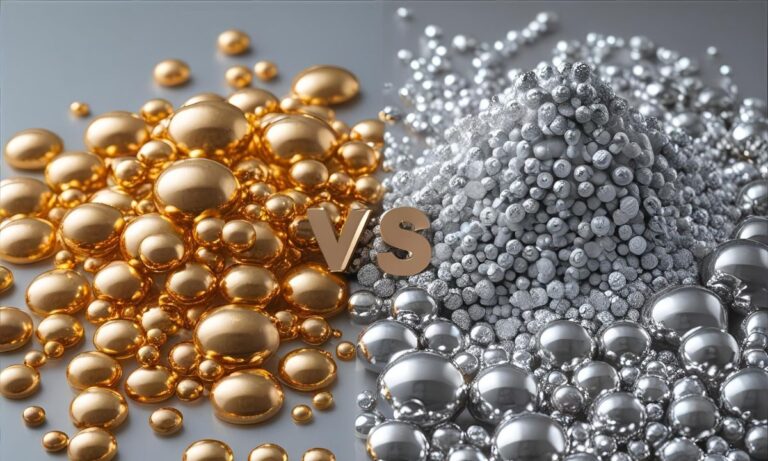
Welcome to this deep dive into the specialized world of gear manufacturing by powder metallurgy. In the high-stakes environment of mechanical engineering, gears are the major components that provide safety for internal parts and prevent foreign particles from entering the system. As we look for an optimum or powerful gear, the process of gear manufacturing by powder metallurgy has emerged as the most important method in the vehicle industry today. Because gear manufacturing by powder metallurgy allows for the combination of specific material properties, we can achieve superior results that traditional methods simply cannot match.
By combining specific material properties together, we can get a superior property that traditional methods struggle to match. This guide explores the secrets of powder metallurgy gear production, explaining why it is a major leap over traditional cutting. For global industries requiring exact specifications, working with experienced manufacturers is essential to ensure the structural integrity of every component. Further technical resources on precision manufacturing and industrial production standards can be explored at diecastingschina.com ou aludiecasting.com.
When we discuss gear manufacturing by powder metallurgy, we are talking about a technology that allows for a near-net shape process. Instead of starting with a massive block of steel and wasting half of it through machining, gear manufacturing by powder metallurgy uses a gear blank, the actual workpiece which is processed to give the final shape of gears. By utilizing fine metal powders in gear manufacturing by powder metallurgy, we can achieve an accurate finishing and close tolerances that reduce the amount of heat generated during the functioning of the gears.
What is Gear Manufacturing by Powder Metallurgy?
In its simplest terms, this technology allows for a near-net shape process. Instead of starting with a massive block of steel and wasting half of it through machining, gear manufacturing by powder metallurgy uses a gear blank, the actual workpiece which is processed to give the final shape of gears.
Beyond “Rough Machining”
Traditional manufacturing usually starts with rough machining, followed by gear cutting and grinding. However, gears made by powder metallurgy are produced through a “molding generation process.” While powder metallurgy gear manufacturing is often associated with simpler shapes, the latest methods offer more freedom in terms of motion and geometry.
This technology allows for the injection molding of metal powders instead of just pressing them. By mixing fine metal powders with a plastic binder, the material flows like a semi-solid under heat and pressure, creating complex three-dimensional shapes that were previously impossible with conventional processes.
The Four-Step Cycle of Powder Metallurgy Gear Production
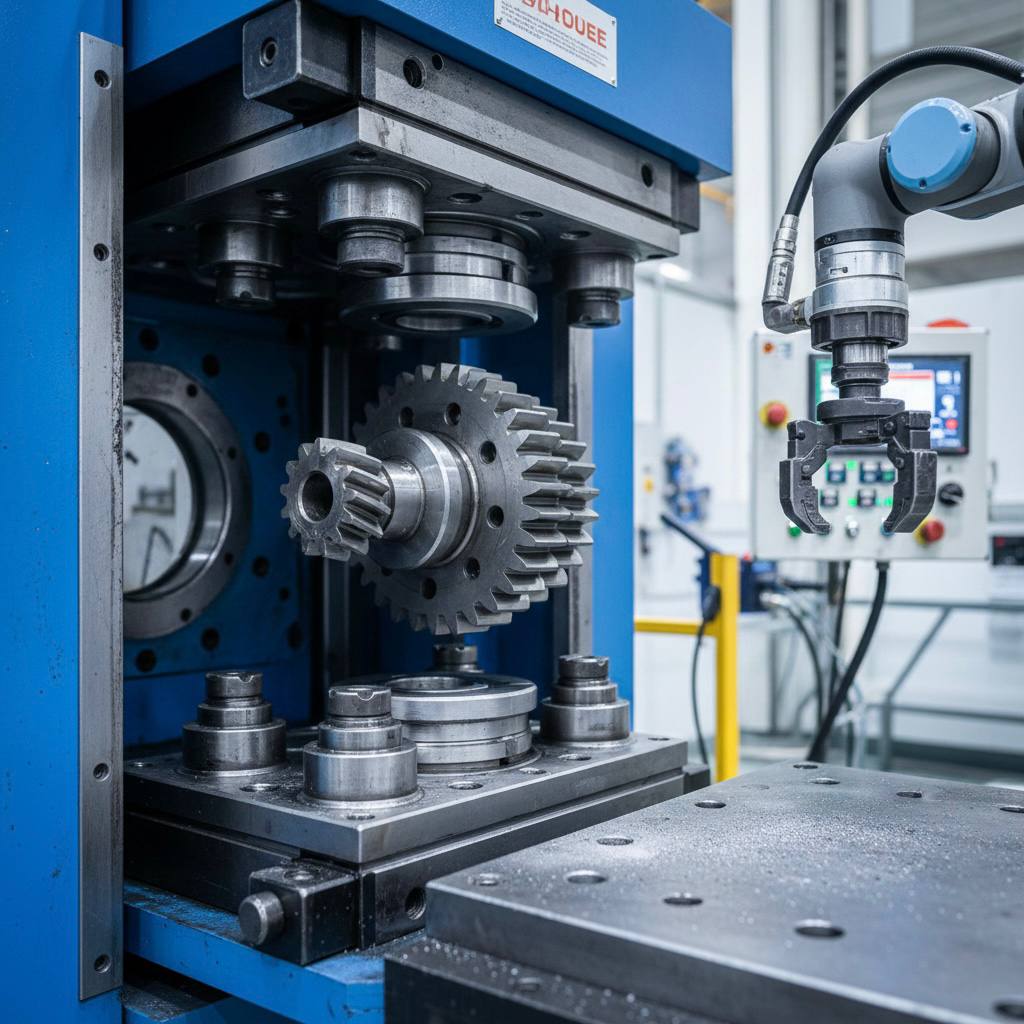
The manufacturing process steps are “n” number, but the powder metallurgy gear production cycle is generally categorized into these critical stages:
Step 1: Blending for “Superior Properties”
The process begins with the materials such as steel, cast iron, aluminum, or stainless steel. Because each material has some properties that may be good or bad, we mix them together to produce an optimum gear. This powder is blended with thermoplastic and wax binders in proportional amounts to make a homogeneous feedstock. This ensures the final product is dimensionally stable; when heat increases, it should not change its shape.
Step 2: Compaction (The Molding Process)
The powder is injected or pressed into a mold cavity. At this stage, we are creating the gear blank. Some machines use blanks without keyways, while others, like motor vehicles, use gears with keyways. These are known as green parts. They have the final shape of the gear but are held together only by plastic binders, meaning they should be handled delicately to avoid damage.
Step 3: Sintering (Inducing Desired Properties)
Next, the gears undergo a method used for obtaining its property, known as sintering. The temperature is changed to induce the desired physical and mechanical properties in the gear. Attention should be given to the temperature, because when it changes slightly from the optimum, the total property will change. Temperatures typically range between 2300°F and 2500°F (1260°C to 1370°C), allowing the metal particles to diffuse and fuse at the atomic level. This results in a 100% metal component with a minimum 97% density.
Step 4: Finishing (Shaving, Grinding, and Lapping)
If you produce a gear that is not finished properly, it will damage the gearbox. Final finishing includes:
- Gear Shaving: Using a special cutter to achieve a smooth finish.
- Gear Grinding: One of the most precise methods, utilizing aluminum oxide or silicon carbide abrasives.
- Lapping: A finishing method used to make the gear noise-free by using a lapping paste while the gear is rotating.
Read more about Powder Metallurgy here: https://www.thediecasting.com/what-is-powder-metallurgy/
Benefits of Gear Manufacturing by Powder Metallurgy
One of the primary advantages of gear manufacturing by powder metallurgy is the incredible design freedom it offers. Components produced by this method lead the industry in mechanical and physical properties. Because the sintering process achieves high density, the final products display very similar material properties to corresponding wrought materials.
Performance Features
- Wear Resistant: Gears suffer from heavy wear by engaging and disengaging, so they must be wear resistant.
- Résistance aux chocs: They must withstand sudden loads or jerks, known as impact strength.
- High Productivity Rate: Faster cycle rates and lower labor costs compared to traditional machining.
- Léger: By using non-ferrous materials or non-metallic recent technology like nylon, we can produce gears that are easy on the vehicle’s power rating.
Selection and Testing: Is Your Gear “Correct”?
There are a certain set of rules for making or manufacturing the gear, such as allowable bending and Hertz stress. Once the gear is made, we must perform gear testing to see whether the gear produced is correct or not, checking how well the accuracy and the tolerance were produced.
We often use a Rockwell hardness tester to check the harness and ensure the surface temperature can be resisted. Mechanical and physical properties are paramount; sintered components can be mechanically worked (drilled or tapped), heat treated to enhance strength, or surface finished through plating and welding.
Is Powder Metallurgy a Good Fit for Your Gear Project?
To determine if powder metallurgy gear production is the right choice, engineers evaluate several factors:
| Criteria | Compatibility for Gears Made by Powder Metallurgy |
| Weight Range | Sweet spot is 0.20g to 30g; viable up to 100g. |
| Épaisseur de la paroi | Best between 2mm and 4mm; minimum 0.3mm. |
| Volume de production | Scalable from 5,000 to millions of units per year. |
| Geometry | High complexity; internal/external threads and integrated hubs. |
Generally, the more complex the part is, the better the application is for gear manufacturing by powder metallurgy. For projects involving lower-melting materials like aluminum or zinc, alternative methods like moulage sous pression de l'aluminium may be required. You can explore these alternatives at diecastingschina.com et aludiecasting.com.
Common Applications for Gears Made by Powder Metallurgy
Powder metallurgy gear production provides the reliable components found in everyday machinery across several sectors:
- Automobile: Transmission gears, oil pump gears, and differential cases rely on the durability of gears made by powder metallurgy.
- Medical and Dental: Intricate components like surgical devices and orthodontic brackets.
- Électronique grand public: High-volume components found in smartphones and high-end audio equipment.
- Firearms: Preferred process for triggers, sights, and hammers due to impact strength requirements.
Troubleshooting and Limitations
While powerful, powder metallurgy gear production has its boundaries. It is important to remember that any metal that melts below 1000°C such as aluminum or zinc cannot be processed through this method easily as the sintering temperatures would cause them to melt completely.
Additionally, we must watch out for common defects:
- Porosité du gaz: Occurs if the mold is too wet or lacks enough vents to let steam escape.
- Fermeture à froid: Where streams of metal fail to fuse due to low temperatures in hybrid processes.
Strategic Global Sourcing from China
When sourcing gears made by powder metallurgy, the location of your production facility matters as much as the technology itself. By utilizing a China-based partner like thediecasting.com, international clients benefit from integrated supply chains that reduce lead times. Modern powder metallurgy gear manufacturing requires not just high-tech presses, but a logistics network that can handle delicate “green parts” and high-density finished goods with equal care.
Choosing a partner with local access to high-grade metal powders and gas atomization facilities ensures that the raw feedstock is never contaminated. This proximity allows for a stress-free structure in the final gear, as the environmental conditions of the raw powder are controlled from day one. This strategic advantage translates directly into lower overhead and faster time-to-market for your most complex mechanical assemblies.
For more information on high-authority manufacturing standards, you can refer to the Metal Powder Industries Federation.
Frequently Asked Questions on Gear Manufacturing by Powder Metallurgy
Why does gear manufacturing by powder metallurgy involve so much shrinkage?
Shrinkage of 15% to 20% is common after sintering. This occurs because the component densifies as metal particles diffuse, eliminating the voids previously occupied by binders. This is mostly isotropic, meaning it happens at the same percentage in all directions.
What is the difference between a “green part” and a “brown part”?
The molded shape is called a green part; it is a consolidation of powder held together by binders. After the debinding stage, where primary binders are removed, the components are then called brown parts.
Why Partner with The Die Casting for Gear Solutions?
Au The Die Casting, we believe in providing the accurate angles and close tolerances your gearbox requires. Based in China, we utilize our talent to become another resource to help our customers achieve their goals. Whether you need a perfectly finished gear or a semi-finished one, our process ensures a stress-free structure.
Our production plants enable us to be 30% to 50% cheaper on product cost compared to competitors. On the right application, gear manufacturing by powder metallurgy can save up to 80% of the component cost. Reach out today for a full CAD review by our engineers.