литьё алюминия под давлением

Компания по литью под давлением цинка

Обзор индустрии компаний, занимающихся литьем под давлением цинка

алюминиевое литьё

Zinc die casting is a manufacturing process that involves the production of intricate and strong metal parts using molten zinc. This is one of the most economical and efficient ways of making high-quality components with high dimensional accuracy. It is a process of injecting molten zinc into a steel mold under high pressure to create parts that are strong, lightweight, and corrosion-resistant. The characteristics of zinc die casting make it suitable for use in industries like automotive, electronics, aerospace, consumer goods and industrial equipment. In today’s manufacturing world, zinc die casting companies are critical because they provide high-quality precision-engineered components specifically what industries need. The majority of these kinds of companies specialize in creating parts with sophisticated shapes, fine surfaces, and tight tolerances. Besides producing high-performance die-cast components, most zinc die casting manufacturers also provide value-added services like designing, tooling, machining and finishing to satisfy customer’s requirements. The zinc die-casting market is spread wide across the globe, from North America to Asia and Europe, and companies are bringing their expertise, technological advancements and manufacturing capabilities to the table. The companies in these regions are known for their innovation, quality and sustainability in the manufacturing process. Using state-of-the-art equipment and advanced technologies they guarantee that each product will be of the highest standard in terms of strength, durability and precision. Zinc die casting is of utmost importance as it is the central process of producing components that enable the functionality of many products we use daily. Zinc die casting companies are important suppliers for industries that need automotive parts such as gears and engine components, electronic housings and medical devices. The demand for high-quality, low-cost components is expected to continue to rise and these zinc die casting companies are expected to be the leaders in innovation, product development and sustainability practices of the die-casting industry. The following sections will cover some of the major players in the zinc die-casting industry, their capabilities and how they contribute to the zinc die-casting market. What is Zinc Die Casting? The manufacturing process of zinc die casting is to inject molten zinc or a zinc alloy under high pressure into pre pre-designed steel mold or die. It quickly solidifies into a metal part that is detailed and uniform without much post-processing. The process, which is very fast, precise, and able to produce lightweight metal parts that are strong enough, is called this. Because of zinc’s unusual properties, such as its low melting point and high fluidity, intricate designs that are difficult to produce with other metals can be made using zinc. Zinc Die Casting Key Characteristics: Because it is repeatable and can produce large amounts of identical parts with very little variation, the process is widely used in mass production. The History and Evolution of Zinc Die Casting The history of zinc die casting goes back to the early 19th century. With the evolution over time, the process has gone through a lot of evolution with the move of the advancement in the materials, machinery and the manufacturing techniques. Early Developments (19th Century) The first die-casting processes occurred in the 1830s and were used to make movable type for printing presses. Although an important printing industry has existed since ancient times, the introduction of die casting substantially changed the printing industry by making the manufacture of metal parts more rapid and more exact. Growth in the 20th Century By the early 1900s, die casting had grown beyond printing to other industries such as automotive and consumer goods. Stronger, more versatile die-cast products were invented in the 1920s when zinc and aluminium alloys were invented. Zinc die casting was all the more essential in World War II since manufacturers required lightweight, tough and high-precision components for military and aircraft production. After the war, the technologies of die casting grew with the expansion of post-war industrial growth. Modern Advancements (21st Century) Today, cutting-edge innovations like automated machines, computer-aided design (CAD) and 3D printing for mod development exist in the use of zinc die casting. The use of recycled zinc has also increased sustainability efforts, which has made die-casting more environmentally friendly. However, due to Industry 4.0, manufacturers are joining robotics, AI autonomous quality control and real-time data monitoring to boost the efficiency of production and decrease defects. This is what has made zinc die casting such an important part of modern manufacturing. Importance of Zinc Die Casting in Modern Manufacturing Zinc die casting is an important part of many industries as it offers manufacturers a dependable, efficient and cost-effective way of producing precision-engineered parts. As such, it becomes increasingly important as industries require lighter, stronger and more complex components for modern applications. 1. Automotive Industry In the automotive sector, zinc die casting is widely used to manufacture: Zinc’s durability, lightweight properties and corrosion resistance make these parts more efficient and more durable, which in turn makes vehicles more efficient and more durable. 2. Electronics and Telecommunications Zinc is a preferred material for electronic devices due to its excellent thermal and electrical conductivity. The following uses zinc die-cast parts: 3. Consumer Goods and Home Appliances Zinc die-cast components are used in many everyday household products such as: Manufacturers can produce durable and aesthetically pleasing components having smooth surface finish using zinc die casting. 4. Industrial and Aerospace Applications Zinc die casting also leads to the production of high precision, lightweight parts that can withstand harsh environments and extreme temperatures and find its use in industrial and aerospace applications. These parts are critical parts for safety and reliability in the critical area. 5. Environmental and Sustainability Benefits Zinc is a fully recyclable metal, so there is less waste produced and reduced manufacturing and sustainability costs. Zinc die casting requires lower energy consumption than other metals and is therefore an eco-friendly option for mass production. The Zinc Die Casting Process There are several critical steps in zinc die casting: 1. The steel mold is coated with a lubricant to ease the release of cast parts during mold preparation. 2. Molten zinc is injected into the
Что такое литье под давлением? Все, что нужно знать о литье металлов

Что такое литье под давлением? Все, что нужно знать о литье металлов

литьё под давлением

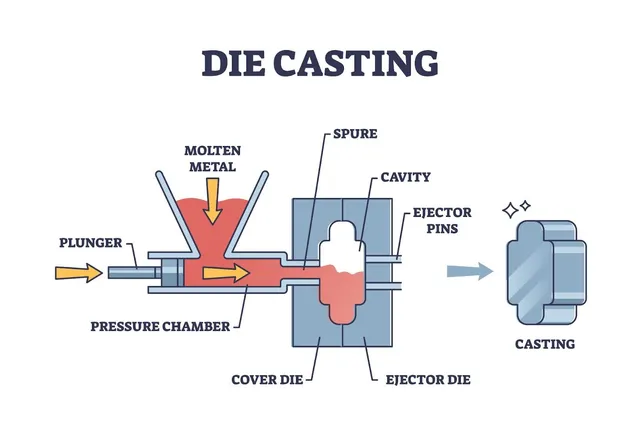
This is a manufacturing process in which molten metal is forced using pressure to fill a mold cavity also known as die casting. The mold is usually of high-quality steel and hence the part can be produced in large quantities the term is used to mean the manufacture of many parts. The finished part is then produced by opening the mold after the molten metal is cooled and forms a solid layer. This kind of use of the process is mostly applied in making intricate metal used in the production of different parts that require high accuracy in measurement and polished surfaces. Die casting can be done on aluminium, zinc, and magnesium but other metals can also be used on a case depending on application and other requirements. Die casting is considered to be one of the expert manufacturing techniques in the conception of mass production of small to medium-sized components out of metals. The popularity of the method has been spread across automotive, aerospace, electronics, and industrial machines due to its ability to produce durable lightweight intricately tailored parts. However, this process is widely recognized for its ability to manufacture products with complex geometry that would be very hard to make using conventional techniques. How Die Casting Works Molding is the first part of the die-casting process. On one side of the mold, there is a half, and it is a half of a particular design to make the mold shaped like the final product. Cavities and cores are designed for the molds that are usually custom-made so that the part can be replicated as closely as possible. 1. Molten Metal Injection: Then the molten metal is injected into the mold cavity under high pressure to form the desired shape. The metal is usually heated to one degree above the melting strain to make it fluid. In die casting, the pressure that the molten metal is pushed into the mold can be from several thousand to tens of thousands of psi (pounds per square inch), to be sure that the molten metal gets into every detail of the mold. 2. Solidification: This occurs when the metal is injected into the casing cavity whereby it cools and the metal hardens. The quality of the casting depends upon the cooling rate. Additional modes of failure (shear, climb, and glide) come into play in this case and result in faster cooling higher strength better surface finish, and slower cooling which could result in more internal defects and lower mechanical properties. Water-cooling systems built into the mold are usually used to assist the cooling process. 3. Ejection: Following this, the metal is allowed to cool and solidify and it is then easy to remove the mold from the larger casting and eject the part. Then most of the time is used in the pushing out part from the mold using a mechanical ejector system. This depends on the complexity of the part that requires other extra steps, namely trimming and machining to deliver the final shape and dimension. 4. Quality Control: A quality check is then performed on a part after ejection. It can involve dimensional verification, visual inspection, and mechanical testing to confirm that the part is equal to or better than the requirements. High precision and repeatability are theoretically achieved in die casting. Types of Die Casting There are two types of Die casting, they are hot chamber die casting and cold chamber die casting. These are all good and have their advantages, limitations and ideal applications. 1. Hot Chamber Die Casting The process most suitable for metals such as zinc, magnesium, and lead is a hot chamber die casting since the process is done at high temperatures, and melting points. The injection system is installed inside the melting furnace in this way, the metal is always in contact with the chamber. Advantages: Disadvantages: 2. Cold Chamber Die Casting The metals that have higher melting points like aluminium, brass and copper are cast in cold chamber die casting. In this case, the molten metal is tapped from a second furnace injected into the cold chamber then into the mold cavity. Advantages: Disadvantages: The Comparison of Die Casting Methods: Hot Chamber vs. Cold Chamber Here is a comparison of the most common types of two die-casting methods, Feature Hot Chamber Die Casting Cold Chamber Die Casting Metal Compatibility Best for low-melting-point metals (e.g., zinc, lead) Best for high-melting-point metals (e.g., aluminium, brass) Cycle Time Faster cycle times Slower cycle times Mold Wear Higher mold wear due to direct contact with molten metal Lower mold wear Cost Lower cost for high-volume production Higher initial cost, but better for high-strength metals Complexity of Parts Good for simpler parts Better for more complex, larger parts Advantages of Die Casting It is one of the largest advantages that die casting is one of the main preferred methods of large-scale production of products from metal alloys. 1. High Precision and Accuracy There are many advantages of die casting, which makes it convenient to offer high die precision. This method of production is also widely used for the production of parts, which requires good dimensional accuracy which is very crucial as it defines tolerance levels required in a specific job. One should note that die casting is the only manufacturing technique that can produce given parts with the utmost complexities such as the intricacies of its geometries.  2. High Production Rates In terms of large volumes, die casting is very efficient. Parts are quickly and cheaply produced once the first mold is created with very little labor involved. The demand for simulated powders is particularly high in industries like automotive and electronics where large volumes of the same parts are required. 3. Complex Designs and Thin Walls Complex design can be achieved by die casting, which would be difficult or impossible to achieve by traditional manufacturing methods. The process can make parts with thin walls, and complex internal structures, and can accommodate undercuts; thus making it the

Обычные производственные дефекты при литье под высоким давлением: Причины, профилактика и решения

алюминиевое литьё, литьё под давлением, литье под высоким давлением

High-pressure die Casting (HPDC) is one of the most frequently utilized metal casting processes in current manufacturing. Manufacturers choose HPDC because it enables the production of complex metal parts that achieve both high precision and rapid production rates superior dimensional accuracy and smooth finishes. HPDC enables automotive and aerospace industries and the production of electronics components and consumer goods to manufacture lightweight durable parts for applications like engines and housings, structural elements, and mechanical assemblies. The manufacturing process of high-pressure die casting faces numerous risks that create substantial defects that decrease product quality while shortening the lifespan and compromising performance. Various defects form from improper mold design, turbulent molten metal flow, trapped gases, inconsistent cooling rates, and thermal stress during the production process. HPDC technology encounters seven primary defects which include porosity, cold shuts, shrinkage defects, flash formation, surface defects, misruns, die erosion, and soldering. These types of manufacturing defects cause deterioration of material strength while producing irregular dimensions and undesirable visual effects which can instigate component breakdown. Manufacturers combat production problems through the optimization of processing parameters and better-undermining methods along with controlled temperature systems and vacuum-assisted casting procedures. Real-time monitoring and simulation software are advanced quality control methods with further efficiency and reliability in the die-casting process. This article provides a comprehensive analysis of standard manufacturing issues during high-pressure die-casting technology with explanations of root causes and solution strategies to decrease these defects. It is only by understanding these challenges and applying best practices that manufacturers can improve the quality, longevity, and, of course, the performance of their die-cast components and simultaneously cut down on waste, and production costs. Proficiency in these manufacturing defects will assist die-casting engineers, production managers, and quality control specialists to optimize their processes for the best die-casting outcomes. 1. Porosity Porosity is defined by small holes or gas inclusions found within the metal matrix, and as a result, affects the mechanical properties, decreasing the strength, including allowing for air and gasses to pass through the structure, and leading to visible surface defects in die-casted products. Causes: Prevention & Solutions: 2. Cold Shut A cold shut is created when two streams of molten metal do not fuse properly and form weak bonding areas or visible seams in the casting. This defect not only decreases the mechanical strength but also increases the risk of a fracture, as well as negatively affects the component’s durability and appearance. Causes: Prevention & Solutions: 3. Shrinkage Defects Shrinkage defects occur due to shrinkage of metal during cooling which leads to internal voids or cavities, which deteriorate the structural integrity of casting. As a result, these defects reduce the mechanical strength of the final product, cause potential failure under stress, and cause poor surface quality, thus affecting both the functionality and aesthetics of the final products. Causes: Prevention & Solutions: 4. Flash Formation Excess thin metal layers formed at the parting line or die gap due to high-pressure metal escape are referred to as flash. Although flash can be trimmed off post-casting, over-flash leads to increased material waste, tool wear, and associated production costs and thus reduces the overall efficiency of the die-casting process. Causes: Prevention & Solutions: 5. Inspection of Surface Defects (Blisters, Crack and Wrinkles) A variety of surface defects, blisters, cracks, and wrinkles, degrade the visual appearance and mechanical strength of the casting and need to be prevented and eliminated. It causes weld defects that reduce the durability of the product, increase the rejection rate, and make the product stick poorly after post-casting treatments such as painting or coating. Causes: Prevention & Solutions: 6. Inclusions and Contamination Unwanted foreign particles, such as slag, oxide films, dirt, or other impurities, which are trapped in a final casting, create poor mechanical properties, weak structural integrity, and surface defects and are called inclusions. The presence of these contaminants can reduce die-cast component performance and durability so that they are not suitable for high-precision applications. Causes: Prevention & Solutions: 7. Misruns and Incomplete Fill A misrun occurs where there is a short filling of the mold cavity, which causes missing sections, thin walls, and weak points in the final component. Negative effects on the structural integrity and functionality of the part and in this way unsuitable for performance applications. Causes: Prevention & Solutions: 8. Die Erosion and Wear Molten erosion dies wear is the loss of the mold surfaces due to the high-speed metal continuously wearing the mold part surfaces until the required dimensions are achieved, which results in poor surface finish and short mold tool life. If this defect occurs, die replacement is common and consequently, production costs increase while casting quality varies. Causes: Prevention & Solutions: 9. Hot Cracking Cracks that occur during the semi-solid state of the metal, is due to high thermal stress and excessive shrinkage are known as hot cracking. These cracks degrade the mechanical integrity of the casting that is increase the chance of failure of the casting at the place where the cracks are present under stress or load. Causes: Prevention & Solutions: 10. Soldering The molten metal adheres to the die surface, which is difficult to remove with casting, causing surface defects, die wear as well as prolonged production downtime. Dimensional inaccuracies and poor surface finish are also caused by this defect, as it results in the overall compromised quality of the final product. Causes: Prevention & Solutions: Conclusion The high-pressure die casting is a powerful manufacturing process that creates complex metal parts at high accuracy at maximum efficiency. However, different kinds of defects arise using improper process parameters, material issues, and/or mold design flaws. Manufacturers can take preventive measures, e.g. optimal process control mold, properly selected material, etc., after understanding these usual manufacturing defects. A company can improve product quality, lower production costs, and achieve higher production efficiency in die-casting operations by emphasizing continuous process improvement as well as defect prevention strategies. Frequently Asked Questions (FAQs) 1. What are the major reasons for defects in high-pressure die casting? The main causes

Выбор подходящей компании по литью сплавов под давлением: Полное руководство

Выбор подходящей компании по литью сплавов под давлением: Полное руководство

литьё алюминия под давлением, литейные предприятия

Alloy die casting is essential to the manufacturing industry because it relies heavily on high precision, durable, and cost-effective metal components. In a revolutionary impact on modern manufacturing, this process has made possible the mass production of intricate metal parts to a very high standard of accuracy and consistency. By specialized companies which as alloy die casting companies, in service industries which as automotive, aerospace, electronics, medical, and heavy machines for building tailor resultant metal components in their specific areas of needs. A professional alloy die casting company makes use of the latest technologies and high-quality materials coupled with a strict quality control process to deliver your products that suit industry standards. If choosing the right company matters, you may choose, one way or another, between a truly reliable product that will last for years and a faulty component that will fail early. The article gives you a detailed overview of Alloy die casting, emphasizing its importance, benefits and the most essential factors to consider when choosing the best Alloy die casting company. Alloy die casting knowledge is essential if you’re a manufacturer seeking the manufacture of precisely engineered parts or a business in search of economic manufacturing options. What is Alloy Die Casting? The metal manufacturing process in which molten metal is injected into a mold (die) under high pressure is called alloy die casting. Implementation of this method is widely used for the production of complex shapes with tight tolerances. The common use of various metal alloys, such as aluminium, zinc, and magnesium, in die casting is because of their good strength properties and corrosion resistance. Types of Alloys Used in Die Casting Alloys used in die casting have a great effect on the selections in the process of die casting, it leads directly to the strength and weight, corrosion resistance and overall performance of the final product. Alloys that differ vary by different industries based on their mechanical properties, durability, and the end use necessary to them. The most commonly used alloys in die casting are mentioned below. 1. Aluminum Alloys A good thermal conductivity, combined with corrosion resistance and lightweight strength, means aluminium die casting is preferred by researchers and manufacturers the world over. In industries that require durable and relatively light components, this alloy type is used. Key Features: Applications: 2. Zinc Alloys Since it has high strength, low melting point and excellent precision, zinc is another commonly used alloy in die casting. For manufacturing small, detailed parts it is ideal. Key Features: Applications: 3. Magnesium Alloys Its lightness makes it extremely suitable to be used for industries seeking to cut weight without compromising on strength, hence this metal is named magnesium. Key Features: Applications: 4. Copper-Based Alloys Brass and bronze are examples of copper-based alloys which are high electrical conductors, corrosion resistant, and good wear resistors. Such alloys are used for applications where the electrical and thermal performance have to be superb. Key Features: Applications: Benefits of Working with a Reliable Alloy Die Casting Company The right alloy die company allows you to select high-quality products that follow industry standards. Here are the key benefits: 1. High Precision and Consistency A top die-casting company has good machinery and rigorous quality control measures to produce the dimensions with very few defects. 2. Cost-Effectiveness Die casting is a very efficient process that also reduces the material and energy costs of the final product significantly compared to other metal-forming processes. 3. Customization and Versatility A custom solution-based casting company is a reputable company that provides custom solutions that are based on particular industry necessities and provides different alloy options. 4. Faster Production and Short Lead Times Automated systems are used in modern die-casting companies to increase their speed of production and meet strict deadlines. 5. Durability and Strength Alloy die-cast parts are well known to be very durable, and thus suitable for use under demanding conditions. How to Choose the Best Alloy Die Casting Company When you select a die-casting manufacturer, you should consider the following: 1. Experience and Industry Expertise Check with the company’s track record, if it had experienced years doing alloy die casting, if its attempt in your industry was proven. 2. Quality Certifications and Standards Make sure the business follows the codec of the industry which might be: 3. Advanced Technology and Equipment To maintain accuracy and reduce the need for physical labor, a modern die-casting company will employ such equipment as a CNC machine, vacuum cast, and robotic automation. 4. Material Selection and Customization Have a company with multiple alloy options and customization so you can find the specific design that your company offers. 5. Strong Supply Chain and On-Time Delivery Efficient logistics and speedy delivery of products are brought about by reliable suppliers. 6. Prototyping and Testing Capabilities Very critical is to prototype and with rigorous quality testing (X-ray inspection and tensile strength) on the product. 7. Competitive Pricing Although price must not be the only consideration, a good die-casting firm can offer competitive prices without sacrificing quality. Industries That Rely on Alloy Die Casting 1. Automotive Industry 2. Aerospace Industry 3. Electronics Industry 4. Medical Equipment 5. Consumer Products Challenges in Alloy Die Casting and How Companies Overcome Them Alloy die casting is a well-known manufacturing process, which faces some challenges and that have an impact on quality, cost and sustainability. Innovative solutions are also implemented by leading alloy die-casting companies to overcome these problems resulting in high-quality production, optimized costs as well and minimized impact on the environment. 1. Managing Porosity and Defects Porosity is one of the most common problems encountered in die casting where gas bubbles or shrinkage cavities occur inside the metal. It can also reduce the structural integrity of the part and impact functionality. This would be addressed by manufacturers using the use of vacuum-assisted die casting, entrapping a minimum amount of air and improved metal density. Moreover, the porosity can be reduced by using pressure-tight casting techniques, design of the mold and proper

Поставщик литья под давлением: Процесс, области применения и основные соображения

Поставщик литья под давлением: Процесс, области применения и основные соображения

Производитель литья под давлением, процесс литья под давлением

It is one of the widely used metal manufacturing processes, and it is highly efficient: producing high precision, durable, and complex components for many Industries. It injects molten metal, like aluminium, Zinc, or magnesium, inside of a steel mold (die) at very high pressure. It provides uniformity, internal strength and smashing surface finishes making it the right choice for use in automotive, aerospace, electronics, medical equipment, as well as consumer goods. A die-casting supplier is a very important company for the manufacture of high-quality parts that satisfy the industry requirements. They are suppliers, who are especially involved in designing, manufacturing and finishing the components or parts utilizing metal with strict tolerances and intricate geometries. Choosing the right supplier matters a lot for the success of any die-casting project as a good supplier should possess adequate expertise, state-of-the-art technology, and a history of successfully delivering precise and low-cost parts.Die casting is efficient in mass production and produces lightweight, yet strong parts, and as a result, the demand for die casting is increasing worldwide. Examples include reducing the weight of a vehicle, and enhancing fuel efficiency, through the use of die-cast aluminum and magnesium components in the automotive industry. In the same way, the electronics industry employs die casting to make heat sinks, enclosures and structural parts that are prone to high durability and electrical conductivity. When looking for a die-casting supplier, one should consider not only manufacturing capabilities but, more importantly, their quality control process, material expertise, and anything that may be left up to the supplier, such as machining, coating, and finishing. This provides a well-established supplier, therefore, reducing lead times, minimal defects and cost-effective production.  In this article, the die-casting process, materials used, the applications, advantages and important considerations of choosing a die-casting supplier are covered. Metal parts required to meet industrial applications need high performance and a reliable supplier fulfils this criterion for both small-batch production and large-scale production. The Die Casting Process: Step-by-Step Guide 1. Mold Preparation Mold (die) preparation and design accompany the initial step of this process. The two-part steel dies consist of a stationary cover die section and the movable ejector die section. Applied lubrication helps the molded flow metallic material smoothly while stopping the material from clinging. 2. Molten Metal Injection The chosen metals aluminum and zinc along with magnesium undergo high-temperature melting. Due to high pressure between 1,500 to 25,000 psi the molten metal enters the mold cavity. High injection pressure produces both accurate and even parts with low levels of flaws. 3. Cooling and Solidification The molten metal quickly reaches solid form during this process when forming parts to their designated shape. The components achieve superior high-strength properties because of the fast cooling process. 4. Ejection of the Part After metal solidification, the mold opens while ejector pins extract the completed part from its chamber. One mold cycle ends when it closes before starting another round of production. 5. Trimming and Finishing Machinists remove all undesirable remnants including flash and both sprees and runners from the part. The component requires supplementary finishing actions which involve sandblasting together with powder coating and anodizing operations to develop superior looks alongside functionality. Differences between Hot Chamber and Cold Chamber die-casting The die-casting process operates in either hot chamber die-casting or cold chamber die-casting formats. The main difference exists in how molten metal receives treatment before mould injection during these two techniques. The two methods differ in specific strengths together with restrictions which make them suitable for particular materials and production needs. The following section provides an elaborate comparison between hot chamber die-casting systems along cold chamber die-casting systems. 1. Process Overview Hot Chamber Die Casting • It requires a built-in furnace, which keeps the metal in a molten state. • Injection system is immersed in the molten metal, sucking it through the injection of a center and supplying it to the mold cavity. • The process is faster since there is no need to convey the metal from an independent melting station as in other processes. Cold Chamber Die Casting • Utilizes an external furnace for heating the metal to produce the required change in its state. • The molten metal is either ladled manually or automatically into the injection system and then it is injected into the mold. • The process is slower than the hot chamber one because the extra step of transferring molten metal takes time. 2. Suitable Metals Hot Chamber Die Casting • Like metals that melt below this temperature such as those that are not suitable to erode the injection system. • Common raw materials include: zinc, magnesium, lead and tin. Cold Chamber Die Casting • Applied to work with metals that have high a melting point which tends to deform the hot chamber system. • Common materials: aluminum, brass, copper, and magnesium alloys. 3. Production Speed Hot Chamber Die Casting • Higher speed of operations normally ranging between 5 to 15 operation cycles per minute. • The direct metal feed helps in avoiding the use of the ladling process in the making of the product. Cold Chamber Die Casting • Some of the disadvantages are the slow cycle times because of manual or fully automated metal transfer. • Other factors may take longer in the cooling and solidification process in this case with some of the alloys. 4. Equipment Durability Hot Chamber Die Casting • The submerged injection system has short service life since it deals with low-melting-point metals. • Longer equipment lifespan with proper maintenance. Cold Chamber Die Casting • Wear and tear increases with the rise in high temperatures especially in the case of aluminum and copper alloys. • Furniture and equipment may last for a shorter time and, therefore, may need constant replacement and maintenance. 5. Cost and Efficiency Hot Chamber Die Casting • High production since the time taken to complete a production cycle is short. • Lower operational costs because of integrated metal handling. Cold Chamber Die Casting • Increased energy costs by

компании по литью алюминия под давлением

Топ-10 компаний по литью алюминия под давлением в Китае и США

литейные предприятия

Вы ищете лучшие компании по литью алюминия под давлением в мировых промышленных центрах? США и Китай за несколько десятилетий стали значимыми участниками мирового рынка услуг по литью алюминия под давлением, предлагая широкий спектр услуг для отраслей, требующих высокой точности. Как и в любой сфере бизнеса, успех проекта обычно зависит от выбранного вами партнера. Наиболее авторитетные и опытные компании, занимающиеся литьем под давлением, всегда гарантируют высокое качество продукции и удовлетворенность результатами. Из-за разнообразия компаний, занимающихся литьем алюминия под давлением в США и Китае, иногда становится сложно найти подходящего партнера для вашего бизнеса. Не беспокойтесь - в этой статье мы сравним 10 ведущих компаний по литью алюминия под давлением в Китае и США. 1. Sincere Tech Co., Ltd. Год основания: Более 15 лет Основные возможности компании: Литье пластмасс, литье алюминия, магния и цинка в пресс-формы/инструменты, механическая обработка, обработка поверхности и услуги по сборке изделий. Адрес: Building 1, No. 30 Huan Zhen Rd, Shang Dong Village, Qi Shi Town, Dongguan City, Guangdong Province, China, P.C.: 523000 Website: www.plasticmold.net Company Overview: Sincere Tech Co., Ltd. является ведущим предприятием по литью алюминия под давлением и изготовлению пресс-форм в Китае, которое расположено в городе Дунгуань, Китай. Она в основном специализируется на высокоточных пресс-формах для литья пластмасс под давлением, алюминиевых пресс-формах для литья под давлением, магниевых и цинковых пресс-формах для литья под давлением, а также пресс-формах для литья пластмасс. Основанная более 15 лет назад, компания развивает исключительные возможности по производству оснастки и литья под давлением для широкого спектра отраслей промышленности. Благодаря современным технологиям и опытному персоналу Sincere Tech предлагает точную продукцию, соответствующую современным промышленным стандартам. Для клиентов из отрасли компьютерной периферии, которым нужны литые детали и/или детали, изготовленные методом литья под давлением, Sincere Tech может взять на себя проектирование, производство, сборку и другие сопутствующие услуги, чтобы обеспечить наилучшее качество и низкую стоимость благодаря единому комплексу услуг. Ключевые услуги Их приверженность качеству: Команда Sincere Tech следит за тем, чтобы каждый разработанный ими продукт соответствовал стандартам качества, принятым в данной сфере. Они применяют надежные меры контроля качества, которые охватывают каждый этап разработки продукта, включая проектирование, создание физических прототипов и сборку. Фирма использует автоматизированную систему, а также включает ручные проверки продукции, чтобы заметить любые недостатки в процессе производства. Кроме того, Sincere Tech является компанией, сертифицированной по стандарту ISO, что подтверждает ее стремление к созданию надежных и долговечных продуктов. Обслуживаемые отрасли: Sincere Tech обслуживает различные отрасли промышленности, включая: Почему стоит выбрать Sincere Tech? Sincere Tech - это поставщик комплексных решений для литых алюминиевых деталей. Они работают в этом бизнесе уже более 15 лет и предоставляют такие услуги, как проектирование, создание прототипов, изготовление инструментов, производство и сборка. Компания предлагает свои решения по низким ценам при сохранении высокого уровня качества. Она также предоставляет хорошие цены и быстрые сроки выполнения для малых и крупных комплексных проектов, независимо от того, планируете ли вы несколько прототипов или 1000 серийных деталей. Если вы ищете компании по литью алюминия под давлением в Китае, которые могли бы предложить вам проектирование и разработку изделий, сборку изделий, литье алюминия под давлением и литье пластмасс под давлением, то они станут одним из лучших вариантов. 2. GC Precision Mold - одна из компаний по литью алюминия под давлением в Китае Год основания: 2005Основные возможности бизнеса: Литье алюминия под давлением (ADC12, A380, AL 6061, 6063 литье под давлением), литье цинка под давлением, точная обработка с ЧПУ, и сборка.Адрес: Dongguan City Qiaotou Town, Jinglian No.40, Donghu Road, Guangdong Province, China.Website: www.thediecasting.com Company Introduction: GC Precision Mold входит в число крупных B2B алюминиевых компаний Китая по литью под давлением. Она была основана в 1999 году. Компания предоставляет такие услуги, как литье алюминия, магния и цинка для различных отраслей промышленности по всему миру. Помимо общего литья под давлением, компания также предлагает высокоточную обработку с ЧПУ, отделку поверхностей и услуги по сборке. Используя современные средства и квалифицированных специалистов, GC Precision Mold предлагает своим клиентам продукцию стандартного качества. Они производят сложные инженерные детали и детали с допусками, а также с отделкой поверхности по стандартам Six Sigma. Компания гарантирует, что ее клиенты получат решения, включающие в себя процессы проектирования и изготовления деталей, вплоть до окончательной сборки пресс-форм, которые соответствуют конкретным фигурам до мельчайших деталей. Приверженность качеству: GC Precision Mold производит продукцию, которая всегда соответствует строгим стандартам качества, таким как ISO 9001:2015. Это диктует высокое качество продукции для клиентов. Компания имеет комплексную процедуру контроля качества, которая гарантирует соответствие продукции установленным стандартам и ее приемлемость для рынка. Обслуживаемые отрасли: GC Precision Mold обслуживает широкий спектр отраслей промышленности, включая: Почему стоит выбрать GC Precision Mold? GC Precision Mold использует современные технологии и квалифицированную рабочую силу для обеспечения удовлетворенности клиентов. Независимо от того, требуется ли клиенту крупносерийное производство или обслуживание прототипов, GC Precision Mold предоставляет лучшие высококачественные услуги по требованию в условиях ограниченного бюджета. Если вы ищете точные решения для литья алюминия под давлением в Китае, вы можете довериться GC Precision mold. Не стесняйтесь запросить мгновенную онлайн-цитату! Если вы ищете компании по литью алюминия под давлением в Китае, которые могли бы предложить вам литье под высоким давлением 6061 и 6063, сборку изделий и литье пластмасс под давлением, то они будут одним из лучших вариантов для вас. 3. CNM Casting Год основания: Более 20 лет Основные возможности бизнеса: Литье алюминия, магния и цинка под давлением, прецизионная обработка на станках с ЧПУ, обработка поверхности и сборка. Адрес: Комната 101, № 40, Donghu Road, Jinglian, Qiaotou Town, Dongguan City, Guangdong Province, China, P.C.: 523520 Веб-сайт: www.thediecasting.com Введение компании: Компания CNM Tech Co., Ltd. была основана более 20 лет назад. Компания находится в городе Дунгуань, Китай, и предоставляет широкий спектр услуг по литью под давлением алюминиевых, магниевых, а также цинковых сплавов. Они также производят сложное литье и точное литье с промышленным применением в автомобилестроении, электронике, аэрокосмической промышленности и бытовой электротехнике. CNM Tech стремится поставлять долговечные и очень сложные детали с точными характеристиками и пространственными размерами, главным образом благодаря ультрасовременному оборудованию и человеческому капиталу, находящемуся в ее распоряжении. Они обслуживают как клиентов, которым требуется скромное количество прототипов, так и клиентов, которым требуются крупные производственные партии по недорогим ценам без ущерба для качества. Еще одним важнейшим аспектом работы CNM Tech является тесное сотрудничество с заказчиком, а также

Преимущества литья под давлением

алюминиевое литьё

Why would a product designer choose a die casting over a component manufactured by another competing process? What are the capabilities of a product made with the die casting? During this session, we will answer those questions. We will also explore the length and breadth of die casting applications, and explain the unique characteristics and optimum die casting configuration. After completing this chapter, you will be able to: List the advantages of using die casting process Identify die casting List the characteristics of the optimum die casting configure Identify the components of the die casting shot The information presented in this chapter is of general interest and is background information for material presented in following chapters. In the previous information you learned general information about the die casting industry in China.  In this chapter you will learn specific information about the die casting. The following new terms are used in this chapter. Die casting “shot”      Defined as a noun in this chapter, not a verb. Sprue                       Cone-shaped metal part of the shot that connects the nozzle and runner. Overflows    Small pockets of metal around the perimeter of the part and also in openings. Runner  The path the metal must flow through to get from the sprue or biscuit to the casting. The Die Casting Advantage Die casting produces components at high speed from a range of durable zinc, magnesium , and aluminum alloys while faithfully capturing the most intricate design details. This capability makes it a prime production option for high volume production components. The ability to maintain close tolerances, often eliminating all machining, can make the process the optimum choice for lower-volume production as well. Modern process technology that insures consistent quality Computer control of the significant process variables has led to consistent dimensional control and internal integrity.  The process responds to statistical control and statistical problem solving techniques. Freedom to design intricate configurations Design configuration is only limited to the designer’s imagination and the mold maker’s ingenuity to build the casting die.  A typical example of an intricate configuration is the automotive transmission valve body. Net-shape casting economies, even at lower volumes Elimination of machining and secondary operations can make die casting competitive at low production volumes. Wide variety of available alloys and alloy properties Recall that the typical metals are alloys of aluminum, magnesium and zinc.  Small volumes of alloys made from copper and lead are also routinely die cast.  Iron and titanium materials have also been die cast.  Current alloy development includes the use of composite materials, aluminum and silicon carbide for example. The rigidity, look and feel of metal The perceived quality of a metal component is higher than that made from a non-metallic material. Rigidity is analogous to strength, and is based on the modulus of elasticity, and configuration.  Good rigidity also reduces vibration. Meets moderate to high strength performance Die cast alloy strengths are above plastics and slightly below those of sheet steels. Moderate to high impact and dent resistance Selected alloys have very high-energy absorption capability. Documented fatigue strength characteristics Published values of fatigue strength are conservative.  High density casting processes minimize defects, such as porosity, that initiate fatigue. Excellent sound damping properties Studies indicate zinc and ZA alloys are good at sound damping. Magnesium has demonstrated sound damping in drive train components. Bearing properties that often eliminate separate bearings ZA alloys have good bearing properties.  Aluminum 390 alloy shows good wear resistance. Inherent EMI shielding for electronic applications High conductivity provides inherent shielding Pressure tightness for hydraulic and pneumatic components Alloy selection, gating technology and vacuum systems greatly reduce trapped gases and shrinkage porosity. High quality surface finishes for decorative applications Good surface finish is relatively easy to achieve.  A variety of surface treatments are easy to apply. Meets criteria for serviceability and recyclability Alloys are “green”, easily recycled.  The aluminum alloys are usually produced from recycled materials. The die casting alloy recycling stream is based on a worldwide metal reclamation infrastructure that has been operative for more than 50 years. Today, with the introduction of new, higher performing die casting alloys and new process technologies, many of the old design assumptions about process limitations have become obsolete. New specifications for dimensional control, draft and flatness have been issued. These specifications are reviewed and updated on a periodic basis. New process enhancements including vacuum technology, squeeze casting, semi-solid casting and thixotropic molding have been developed and have led to significantly reduced levels of porosity. The Optimum Die Casting Configuration Before a die casting project is undertaken, the casting design should be evaluated in terms of manufacturability.  In other words, can the casting be manufactured?  Is the casting design optimum? The optimum die casting configuration will: Fill completely with metal. Solidify quickly without defects. Eject readily from the die. The optimum casting configuration does not just happen. Engineers and designers must work together to make sure the casting design fulfills the product requirements and can be manufactured.  To achieve both of these goals, the die casting must be designed with features that capitalize on the characteristics of the die casting process.  The following six principles should be used in working toward and developing the optimum die casting configuration.

Алюминиевые аэрокосмические детали

Литье алюминия под давлением и его значение для аэрокосмической промышленности

алюминиевое литьё, алюминиевые литейные формы, литьё алюминия под давлением, литье алюминия под давлением, литейные предприятия, литейная компания

Алюминиевые изделия, полученные методом литья под давлением, находят широкое применение в различных отраслях промышленности, и в первую очередь в аэрокосмическом машиностроении, где точность и высокий стандарт изделий имеют огромное значение. Эти изделия используются для создания как маленьких, так и больших компонентов в авиационной промышленности. Кроме того, литье алюминия под давлением используется как в важнейшем военном секторе, так и в коммерческом. Причина проста - это экономически выгодные решения и потрясающие результаты. Помимо экономичности, детали, изготовленные из литого под давлением алюминия, также готовы выдерживать экстремальные погодные условия и повышенные повреждения. Еще одна важная причина использования алюминиевых изделий в авиации - сравнительная доступность по сравнению с другими металлами, из которых производится литье под давлением. Кроме того, алюминий способен соединяться с другими металлами для обеспечения прочности и гибкости. При использовании литых алюминиевых изделий вам не придется идти на компромисс со стандартами, но при этом вы сможете получить их по вполне доступной цене. Далее, все стандарты, которые были установлены для использования металлических компонентов, алюминий расслабляет необходимость в максимальной степени. Поэтому они сертифицированы как безопасные для использования в самолетах, доступны по цене и обладают всеми качествами, необходимыми для летающих аппаратов. Поэтому литье алюминия сейчас на подъеме, как никогда раньше. Кроме того, самое главное в алюминиевых деталях, отлитых под давлением, - это их вес, что благоприятно сказывается на работе самолета. Так как же на самом деле происходит литье алюминия и какие процессы при этом происходят? Ну, ответ прост. Алюминиевый сплав сначала вдавливается в высококачественную сталь на высокой скорости и при высокой температуре. В результате получаются изделия высшего стандарта, очень легкие и тонкостенные, идеально подходящие для использования в качестве компонентов самолетов. Следует отметить, что диетическое литье алюминия - сложная технология. Только действительно опытная и высококлассная команда инженеров может гарантировать, что детали получатся с максимальными объемами или с отличными допусками и отделкой поверхности. На самом деле, этот вид силового литья гораздо более известен, чем гравитационное литье или литье в песчаные формы. Это связано с тем, что потребность в механической обработке при этом типе литья чрезвычайно низка из-за близких допусков. Хотя стоимость оснастки при литье алюминия или любого другого металла значительно выше, чем у двух других типов, механические свойства, достигаемые таким образом, намного лучше с точки зрения функциональности.

Литье под давлением с цинком

Значение литья под давлением цинка в автомобильной промышленности

литье алюминия под давлением, литейные предприятия, литейная компания, Производитель литья под давлением, литейные детали, литье под давлением zamak 3, Цинковое литье Zamak 3, замак 5, литье под давлением zamak 5, литьё под давлением zamak, литье под давлением цинкового сплава, Литье под давлением с цинком

Что такое литье под давлением? Литье под давлением - это процесс литья металлов, который характеризуется выдавливанием расплавленного металла в полость формы. Для изготовления полости формы используются две закаленные формы из инструментальной стали, которые обрабатываются в процессе производства и работают аналогично литьевым формам. В основном литье под давлением производится из цветных металлов, в частности цинка, меди, алюминия, магния, олова, свинца и сплавов на основе олова. В зависимости от типа металла для литья используется термический или холодный двигатель. Процесс литья под давлением цинка очень популярен для изготовления деталей в строительстве и промышленности, но наиболее распространено его применение в автомобилестроении. Фактически, автомобили имеют различные детали, которые могут быть изготовлены с помощью литья под давлением, так что современный процесс литья под давлением изначально был начат для автомобильной промышленности. При литье под давлением часто не требуется никакой дополнительной обработки после литья: точность не только достигает 99,8%, но и литые изделия можно использовать в сыром виде, поскольку они имеют приятную отделку. Литье цинка под давлением используется почти 28% в автомобильной промышленности, за которой следует строительный и хозяйственный сектор. Цинк стал одним из самых важных металлов в индустрии автозапчастей, особенно для таких изделий, как корпус дверного замка, щеколда, шестерни и втягивающие шкивы в системах ремней безопасности, а также для компонентов распределительного вала и датчиков. Используя этот металл и его сплавы, можно добиться прочности, пластичности и гибкости, которые невозможны при использовании других материалов. Кроме того, цинк может стать правильным выбором для получения высококачественных эстетических компонентов с жесткими допусками, которые невозможны при использовании других материалов, а также для получения тиснения и канавок для механических компонентов или шестеренок. Механизмы литья под давлением цинка в автомобилестроении Как уже говорилось, автомобильная промышленность является наиболее распространенной областью применения литья под давлением: использование цинка и его сплавов позволяет производить компоненты, способные достичь высокого эстетического качества, с жесткими и узкими допусками на морфологию формы. Цинковые сплавы также используются для нанесения покрытий благодаря своим многочисленным преимуществам, таким как улучшение антикоррозионных свойств цинка, которые и так впечатляют. Ниже вы найдете несколько возможных примеров цинкового покрытия: Эстетика интерьера Раздел Люки Раздел Механические части Двигатель и другие компоненты подкапотного пространства Усилитель рулевого управления Детали и тормозная система Компоненты и системы кондиционирования воздуха Ходовая часть Детали системы ремней безопасности Компоненты климат-контроля Топливная система Преимущества литья под давлением из цинка: Эффективный и экономичный процесс, предлагающий различные формы. Высокоскоростное производство Точность размеров и стабильность Прочность и вес Доступны несколько технологий отделки Простая сборка Процесс литья под давлением начался с использования свинца и свинцовых сплавов, магниевых и медных сплавов, которые быстро последовали за ним, и в 1930-х годах были доступны многие современные сплавы, используемые и сегодня. Этот процесс развивался от литья под низким давлением до современного впрыска под высоким давлением в 4500 фунтов на квадратный дюйм. Современный процесс позволяет получать высокопрочные, чистые литейные формы с превосходной отделкой поверхности. Цинковый литейный сплав - это прочный, долговечный и экономически эффективный инженерный материал. Их механические свойства конкурентоспособны и обычно выше, чем у литого алюминия, магния, бронзы, пластика и большинства видов чугуна.

Литье под давлением с цинком

Выгодное производство для процессов литья под давлением цинка

литьё алюминия под давлением, литье алюминия под давлением, литейные предприятия, Литье под давлением с цинком

Процесс литья под давлением можно проследить до середины 1800 года. В качестве компонентов использовались олово и свинец, но их применение исчезло с появлением сплавов цинка и алюминия. Этот процесс развивался на протяжении многих лет, начиная с форм для литья под низким давлением и заканчивая формами для литья под давлением до 4 500 фунтов на квадратный дюйм. Этот процесс позволяет создавать высококачественные изделия с превосходной конечной поверхностью. Литье под давлением - это экономичный и эффективный процесс изготовления различных форм. Считается, что он превосходит другие технологии производства, является долговечным и эстетичным и прекрасно сочетается с другими частями машины, которые являются его частью. Высечка имеет множество преимуществ. Среди них главное - способность производить сложные формы с более высоким уровнем допуска, чем при других методах массового производства. Можно изготовить тысячи одинаковых оттисков, прежде чем потребуется добавлять новые формообразующие инструменты. Высокая штамповка - это производственный процесс, при котором расплавленный алюминий впрыскивается литейной машиной под экстремальным давлением в сталь или формы для изготовления дизайна и деталей модели, которую вы хотите сделать. Отливка в тоннах универсальной затяжки. Эта запись отражает величину давления, оказываемого на матрицу. Размер двигателя варьируется от 400 до 4000 тонн. Существует множество преимуществ использования процесса литья под давлением по сравнению с другими. Литье под давлением позволяет получать детали с более тонкими стенками, узкими границами размеров и ускорять процессы. Затраты на рабочую силу и отделку при литье под давлением самые низкие. Этот процесс позволяет получать замысловатые формы с более узкими допусками. В отличие от процесса подделки, в изделие, созданное этим способом, можно вставить ядро. Формы, которые невозможно получить из стержней или трубок, легко достигаются с помощью литья. Количество операционных процессов меньше, что приводит к сокращению отходов материалов. Литье под давлением используется в тех случаях, когда вам нужен стабильный, размерный и прочный компонент. Они выдерживают нагрев и сохраняют хороший уровень допусков, что является важным условием для каждой детали хорошей машины. Они прочнее и легче, чем детали, изготовленные другими методами печати. Его детали не свариваются и не скручиваются, что значительно повышает его эффективность. Еще одно преимущество - множество возможностей, которые можно получить при запуске. Поверхности могут быть гладкими или текстурированными, что облегчает нанесение и использование. Надеемся, эта информация поможет вам и благодарим за прочтение статьи о цинковом литье.

Прокрутить вверх

Получить цитату