
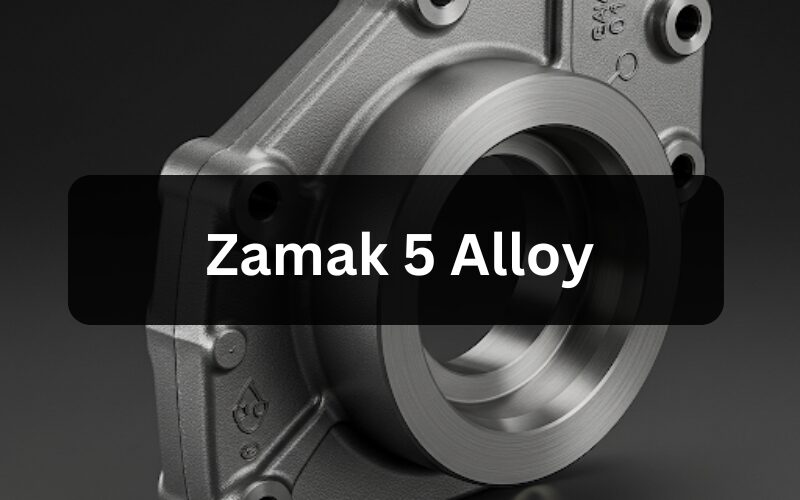
En omfattende guide til Zamak 5 Alloy: Egenskaber, støbning og anvendelser
zamak 5 trykstøbningOne such alloy that is widely used in manufacturing and casting industries is the zinc-based Zamak 5 alloy, which has some unique features. This is because of the great strength, excellent durability and great corrosion resistance, which Zamak 5 offers, making it an ideal material for use in die casting operations. After extraction, Zamak 5 is extremely low-melting and has excellent casting characteristics, thus making Zamak 5 an ideal material for automotive manufacturing and consumer products and hardware industries. Industry participants will have the certainty about Zamak 5 alloy properties, such as composition and various concrete usages, to make production decisions and optimize the process of operational effectiveness. The article discusses Zamak 5 alloy through its chemical makeup and the manufacturing methods alongside temperature control and pressure maintenance, and mechanical substance attributes on the industrial performance. Zamak 5 Alloy Overview Zamak 5 functions as a leading zinc-based alloy that industry refers to as zinc-aluminum alloy. Zamak 5 is chemically composed of 3.5 to 4.3 percent aluminum along 0.03 to 0.08 percent magnesium, and 0.75 to 1.25 percent copper. It also gets its superior strength due to the elements that the manufacturer can use to create high-strength components for use in the automotive and aerospace, and consumer goods industries. The tensile strength, as well as 6.7 g/cm³ density and a relatively wide melting point range of 380-385°C, are present in this alloy because of its good durability and good precision. Composition and Properties of Zamak 5 Chemical Composition of Zamak 5 Mechanical properties of Zamak 5 are improved by mixing in a zinc-based alloy in controlled percentages of zinc and aluminum and copper, and magnesium. This property of easy melting is one of the qualities that makes Zamak 5 an excellent die casting alloy in comparison with 96–98% of the alloy that is ZINC. For the achievement of superior results, it is critical to use zinc material with 99.99% purity in order to avoid contaminants that would impair the alloy strength and structural integrity.The solidification of Zamak 5 material is improved by the addition of Aluminum (3.5 to 4.3%) as it improves the alloy’s microstructure. The regions have e composition forming them that combines ductility and hardness features in the material structure. Zamak needed to be measured for the exact aluminum content to prevent material defects like cracking as well as brittleness problems.The presence of magnesium between 0.03% to 0.08% in zamak 5 is because with this element, the corrosion of micro cracks in grain boundaries is blocked by impurities. Because this addition makes the alloy more fluid, the mold benefits by obtaining better filling features. Leaving out magnesium will make the Zamak 5 surface defective, as well as being very hard to machine.Zamak 5 is graphite casted and has good wear resistance and heat treating capability when the amount of copper is added at 0.75 to 1.25 percent, which has enhanced creep resistance, which is appropriate for thermal variation applications. Because Zamak 5 becomes brittle when the correct limits are exceeded, the ratio of copper is important. Physical Properties of Zamak 5 The weight of a Zamak 5 material is 6.7 g/cm³ with a density between steel and greater than the aluminum alloys. Its favorable weight-to-strength relation makes Zamak 5 suitable for many structures involving strong materials with low weights. Zamak 5 melts between 380 and 385 degrees Celsius, which makes the exact casting of zamak 5 cost-effective compared to aluminum. At a mean temperature of 120 °C, the tensile strength of Zamak 5 was 330 MPa with 220 MPa yield strength and elongation potential of 7-10%, which meets the requirements of industrial use. Zamak 5 is strong and adaptable as it has high yield strength at 220 MPa and the maximum elongation before almost failure of 7-10%. Mechanical Properties of Zamak 5 Zamak 5 has 91 HB Brinell hardness levels perfectly struck in between strength and surface hardness, making it an excellent combination for decorative handles or other parts demanding wear protection. Impact Resistance: The measure of room temperature Charpy impact strength of the material is 53 J, while at -20°C it reduces to 35 J. The alloy has high impact resistance so that it can protect itself against mechanical stresses and vibrations in dynamic force conditions.Zamak 5 can stand up to cyclic stress of 100 MPa and survive without failure up to 1 million cycles. Zamak 5 performs in practice with reliable stability under continuous loading, thus being suitable for the machine components and the washing machine part. Mechanical Properties of Zamak 5 Alloy A table below displays essential mechanical characteristics of Zamak 5 aluminum alloy. Property Value Brinell Hardness 91 HB Ultimate Tensile Strength 328 MPa Yield Strength (0.2%) 269 MPa Shear Strength 262 MPa Compressive Strength 600 MPa Fatigue Strength 56.5 MPa Impact Strength 65 J Modulus of Elasticity 96 GPa Elongation 7% in 50mm Zamak alloy’s strength values show how it can withstand stress and place it within other materials where it can be used in demanding applications. Zamak 5 provides superior resistance to fatigue loads and impacts, thus suitable for parts subjected to repeated force loadings. Physical Properties of Zamak 5 Alloy Through its full set of characteristics, Zamak 5’s behavior is controlled by the physical properties. Property Value Melting Range 380-386°C Density 6.60 g/cm³ Electrical Conductivity 26% IACS Thermal Conductivity 109 W/mK Specific Heat Capacity 419 J/kg-°C Coefficient of Thermal Expansion 27.4 µm/m°K Poisson’s Ratio 0.30 The combination of properties in Zamak 5 makes it perform well in different settings and for application conditions that are suitable for thermal as well as electrical conductivity. Appropriate density characteristics and thermal ability make Zamak 5 to must for warm sensitive systems and also possesses good electrical properties, which provide a variety in an use form of an electrical part. Advantages of Zamak 5 Alloy In comparison, the superior strength properties that Zamak 5 exhibits at the same time with lower weight are because its strength-to-weight ratio is 49 MPa, which exceeds A380 aluminum. Due