aluminum die casting

Zinc Die Casting Company

Overview of Zinc Die Casting Companies Industry

aluminum casting

Zinc die casting is a manufacturing process that involves the production of intricate and strong metal parts using molten zinc. This is one of the most economical and efficient ways of making high-quality components with high dimensional accuracy. It is a process of injecting molten zinc into a steel mold under high pressure to create parts that are strong, lightweight, and corrosion-resistant. The characteristics of zinc die casting make it suitable for use in industries like automotive, electronics, aerospace, consumer goods and industrial equipment. In today’s manufacturing world, zinc die casting companies are critical because they provide high-quality precision-engineered components specifically what industries need. The majority of these kinds of companies specialize in creating parts with sophisticated shapes, fine surfaces, and tight tolerances. Besides producing high-performance die-cast components, most zinc die casting manufacturers also provide value-added services like designing, tooling, machining and finishing to satisfy customer’s requirements. The zinc die-casting market is spread wide across the globe, from North America to Asia and Europe, and companies are bringing their expertise, technological advancements and manufacturing capabilities to the table. The companies in these regions are known for their innovation, quality and sustainability in the manufacturing process. Using state-of-the-art equipment and advanced technologies they guarantee that each product will be of the highest standard in terms of strength, durability and precision. Zinc die casting is of utmost importance as it is the central process of producing components that enable the functionality of many products we use daily. Zinc die casting companies are important suppliers for industries that need automotive parts such as gears and engine components, electronic housings and medical devices. The demand for high-quality, low-cost components is expected to continue to rise and these zinc die casting companies are expected to be the leaders in innovation, product development and sustainability practices of the die-casting industry. The following sections will cover some of the major players in the zinc die-casting industry, their capabilities and how they contribute to the zinc die-casting market. What is Zinc Die Casting? The manufacturing process of zinc die casting is to inject molten zinc or a zinc alloy under high pressure into pre pre-designed steel mold or die. It quickly solidifies into a metal part that is detailed and uniform without much post-processing. The process, which is very fast, precise, and able to produce lightweight metal parts that are strong enough, is called this. Because of zinc’s unusual properties, such as its low melting point and high fluidity, intricate designs that are difficult to produce with other metals can be made using zinc. Zinc Die Casting Key Characteristics: Because it is repeatable and can produce large amounts of identical parts with very little variation, the process is widely used in mass production. The History and Evolution of Zinc Die Casting The history of zinc die casting goes back to the early 19th century. With the evolution over time, the process has gone through a lot of evolution with the move of the advancement in the materials, machinery and the manufacturing techniques. Early Developments (19th Century) The first die-casting processes occurred in the 1830s and were used to make movable type for printing presses. Although an important printing industry has existed since ancient times, the introduction of die casting substantially changed the printing industry by making the manufacture of metal parts more rapid and more exact. Growth in the 20th Century By the early 1900s, die casting had grown beyond printing to other industries such as automotive and consumer goods. Stronger, more versatile die-cast products were invented in the 1920s when zinc and aluminium alloys were invented. Zinc die casting was all the more essential in World War II since manufacturers required lightweight, tough and high-precision components for military and aircraft production. After the war, the technologies of die casting grew with the expansion of post-war industrial growth. Modern Advancements (21st Century) Today, cutting-edge innovations like automated machines, computer-aided design (CAD) and 3D printing for mod development exist in the use of zinc die casting. The use of recycled zinc has also increased sustainability efforts, which has made die-casting more environmentally friendly. However, due to Industry 4.0, manufacturers are joining robotics, AI autonomous quality control and real-time data monitoring to boost the efficiency of production and decrease defects. This is what has made zinc die casting such an important part of modern manufacturing. Importance of Zinc Die Casting in Modern Manufacturing Zinc die casting is an important part of many industries as it offers manufacturers a dependable, efficient and cost-effective way of producing precision-engineered parts. As such, it becomes increasingly important as industries require lighter, stronger and more complex components for modern applications. 1. Automotive Industry In the automotive sector, zinc die casting is widely used to manufacture: Zinc’s durability, lightweight properties and corrosion resistance make these parts more efficient and more durable, which in turn makes vehicles more efficient and more durable. 2. Electronics and Telecommunications Zinc is a preferred material for electronic devices due to its excellent thermal and electrical conductivity. The following uses zinc die-cast parts: 3. Consumer Goods and Home Appliances Zinc die-cast components are used in many everyday household products such as: Manufacturers can produce durable and aesthetically pleasing components having smooth surface finish using zinc die casting. 4. Industrial and Aerospace Applications Zinc die casting also leads to the production of high precision, lightweight parts that can withstand harsh environments and extreme temperatures and find its use in industrial and aerospace applications. These parts are critical parts for safety and reliability in the critical area. 5. Environmental and Sustainability Benefits Zinc is a fully recyclable metal, so there is less waste produced and reduced manufacturing and sustainability costs. Zinc die casting requires lower energy consumption than other metals and is therefore an eco-friendly option for mass production. The Zinc Die Casting Process There are several critical steps in zinc die casting: 1. The steel mold is coated with a lubricant to ease the release of cast parts during mold preparation. 2. Molten zinc is injected into the
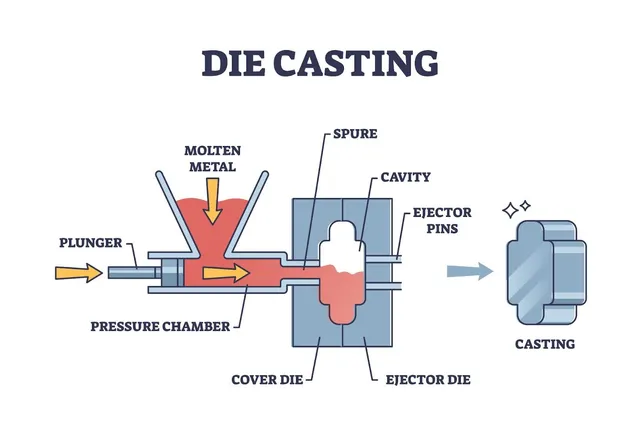
What is Die Casting? Everything You Need to Know About Metal Casting

What is Die Casting? Everything You Need to Know About Metal Casting

die casting

This is a manufacturing process in which molten metal is forced using pressure to fill a mold cavity also known as die casting. The mold is usually of high-quality steel and hence the part can be produced in large quantities the term is used to mean the manufacture of many parts. The finished part is then produced by opening the mold after the molten metal is cooled and forms a solid layer. This kind of use of the process is mostly applied in making intricate metal used in the production of different parts that require high accuracy in measurement and polished surfaces. Die casting can be done on aluminium, zinc, and magnesium but other metals can also be used on a case depending on application and other requirements. Die casting is considered to be one of the expert manufacturing techniques in the conception of mass production of small to medium-sized components out of metals. The popularity of the method has been spread across automotive, aerospace, electronics, and industrial machines due to its ability to produce durable lightweight intricately tailored parts. However, this process is widely recognized for its ability to manufacture products with complex geometry that would be very hard to make using conventional techniques. How Die Casting Works Molding is the first part of the die-casting process. On one side of the mold, there is a half, and it is a half of a particular design to make the mold shaped like the final product. Cavities and cores are designed for the molds that are usually custom-made so that the part can be replicated as closely as possible. 1. Molten Metal Injection: Then the molten metal is injected into the mold cavity under high pressure to form the desired shape. The metal is usually heated to one degree above the melting strain to make it fluid. In die casting, the pressure that the molten metal is pushed into the mold can be from several thousand to tens of thousands of psi (pounds per square inch), to be sure that the molten metal gets into every detail of the mold. 2. Solidification: This occurs when the metal is injected into the casing cavity whereby it cools and the metal hardens. The quality of the casting depends upon the cooling rate. Additional modes of failure (shear, climb, and glide) come into play in this case and result in faster cooling higher strength better surface finish, and slower cooling which could result in more internal defects and lower mechanical properties. Water-cooling systems built into the mold are usually used to assist the cooling process. 3. Ejection: Following this, the metal is allowed to cool and solidify and it is then easy to remove the mold from the larger casting and eject the part. Then most of the time is used in the pushing out part from the mold using a mechanical ejector system. This depends on the complexity of the part that requires other extra steps, namely trimming and machining to deliver the final shape and dimension. 4. Quality Control: A quality check is then performed on a part after ejection. It can involve dimensional verification, visual inspection, and mechanical testing to confirm that the part is equal to or better than the requirements. High precision and repeatability are theoretically achieved in die casting. Types of Die Casting There are two types of Die casting, they are hot chamber die casting and cold chamber die casting. These are all good and have their advantages, limitations and ideal applications. 1. Hot Chamber Die Casting The process most suitable for metals such as zinc, magnesium, and lead is a hot chamber die casting since the process is done at high temperatures, and melting points. The injection system is installed inside the melting furnace in this way, the metal is always in contact with the chamber. Advantages: Disadvantages: 2. Cold Chamber Die Casting The metals that have higher melting points like aluminium, brass and copper are cast in cold chamber die casting. In this case, the molten metal is tapped from a second furnace injected into the cold chamber then into the mold cavity. Advantages: Disadvantages: The Comparison of Die Casting Methods: Hot Chamber vs. Cold Chamber Here is a comparison of the most common types of two die-casting methods, Feature Hot Chamber Die Casting Cold Chamber Die Casting Metal Compatibility Best for low-melting-point metals (e.g., zinc, lead) Best for high-melting-point metals (e.g., aluminium, brass) Cycle Time Faster cycle times Slower cycle times Mold Wear Higher mold wear due to direct contact with molten metal Lower mold wear Cost Lower cost for high-volume production Higher initial cost, but better for high-strength metals Complexity of Parts Good for simpler parts Better for more complex, larger parts Advantages of Die Casting It is one of the largest advantages that die casting is one of the main preferred methods of large-scale production of products from metal alloys. 1. High Precision and Accuracy There are many advantages of die casting, which makes it convenient to offer high die precision. This method of production is also widely used for the production of parts, which requires good dimensional accuracy which is very crucial as it defines tolerance levels required in a specific job. One should note that die casting is the only manufacturing technique that can produce given parts with the utmost complexities such as the intricacies of its geometries.  2. High Production Rates In terms of large volumes, die casting is very efficient. Parts are quickly and cheaply produced once the first mold is created with very little labor involved. The demand for simulated powders is particularly high in industries like automotive and electronics where large volumes of the same parts are required. 3. Complex Designs and Thin Walls Complex design can be achieved by die casting, which would be difficult or impossible to achieve by traditional manufacturing methods. The process can make parts with thin walls, and complex internal structures, and can accommodate undercuts; thus making it the

Usual Manufacturing Defects in High-Pressure Die Casting: Causes, Prevention, and Solutions

aluminum casting, die casting, high pressure die casting

High-pressure die Casting (HPDC) is one of the most frequently utilized metal casting processes in current manufacturing. Manufacturers choose HPDC because it enables the production of complex metal parts that achieve both high precision and rapid production rates superior dimensional accuracy and smooth finishes. HPDC enables automotive and aerospace industries and the production of electronics components and consumer goods to manufacture lightweight durable parts for applications like engines and housings, structural elements, and mechanical assemblies. The manufacturing process of high-pressure die casting faces numerous risks that create substantial defects that decrease product quality while shortening the lifespan and compromising performance. Various defects form from improper mold design, turbulent molten metal flow, trapped gases, inconsistent cooling rates, and thermal stress during the production process. HPDC technology encounters seven primary defects which include porosity, cold shuts, shrinkage defects, flash formation, surface defects, misruns, die erosion, and soldering. These types of manufacturing defects cause deterioration of material strength while producing irregular dimensions and undesirable visual effects which can instigate component breakdown. Manufacturers combat production problems through the optimization of processing parameters and better-undermining methods along with controlled temperature systems and vacuum-assisted casting procedures. Real-time monitoring and simulation software are advanced quality control methods with further efficiency and reliability in the die-casting process. This article provides a comprehensive analysis of standard manufacturing issues during high-pressure die-casting technology with explanations of root causes and solution strategies to decrease these defects. It is only by understanding these challenges and applying best practices that manufacturers can improve the quality, longevity, and, of course, the performance of their die-cast components and simultaneously cut down on waste, and production costs. Proficiency in these manufacturing defects will assist die-casting engineers, production managers, and quality control specialists to optimize their processes for the best die-casting outcomes. 1. Porosity Porosity is defined by small holes or gas inclusions found within the metal matrix, and as a result, affects the mechanical properties, decreasing the strength, including allowing for air and gasses to pass through the structure, and leading to visible surface defects in die-casted products. Causes: Prevention & Solutions: 2. Cold Shut A cold shut is created when two streams of molten metal do not fuse properly and form weak bonding areas or visible seams in the casting. This defect not only decreases the mechanical strength but also increases the risk of a fracture, as well as negatively affects the component’s durability and appearance. Causes: Prevention & Solutions: 3. Shrinkage Defects Shrinkage defects occur due to shrinkage of metal during cooling which leads to internal voids or cavities, which deteriorate the structural integrity of casting. As a result, these defects reduce the mechanical strength of the final product, cause potential failure under stress, and cause poor surface quality, thus affecting both the functionality and aesthetics of the final products. Causes: Prevention & Solutions: 4. Flash Formation Excess thin metal layers formed at the parting line or die gap due to high-pressure metal escape are referred to as flash. Although flash can be trimmed off post-casting, over-flash leads to increased material waste, tool wear, and associated production costs and thus reduces the overall efficiency of the die-casting process. Causes: Prevention & Solutions: 5. Inspection of Surface Defects (Blisters, Crack and Wrinkles) A variety of surface defects, blisters, cracks, and wrinkles, degrade the visual appearance and mechanical strength of the casting and need to be prevented and eliminated. It causes weld defects that reduce the durability of the product, increase the rejection rate, and make the product stick poorly after post-casting treatments such as painting or coating. Causes: Prevention & Solutions: 6. Inclusions and Contamination Unwanted foreign particles, such as slag, oxide films, dirt, or other impurities, which are trapped in a final casting, create poor mechanical properties, weak structural integrity, and surface defects and are called inclusions. The presence of these contaminants can reduce die-cast component performance and durability so that they are not suitable for high-precision applications. Causes: Prevention & Solutions: 7. Misruns and Incomplete Fill A misrun occurs where there is a short filling of the mold cavity, which causes missing sections, thin walls, and weak points in the final component. Negative effects on the structural integrity and functionality of the part and in this way unsuitable for performance applications. Causes: Prevention & Solutions: 8. Die Erosion and Wear Molten erosion dies wear is the loss of the mold surfaces due to the high-speed metal continuously wearing the mold part surfaces until the required dimensions are achieved, which results in poor surface finish and short mold tool life. If this defect occurs, die replacement is common and consequently, production costs increase while casting quality varies. Causes: Prevention & Solutions: 9. Hot Cracking Cracks that occur during the semi-solid state of the metal, is due to high thermal stress and excessive shrinkage are known as hot cracking. These cracks degrade the mechanical integrity of the casting that is increase the chance of failure of the casting at the place where the cracks are present under stress or load. Causes: Prevention & Solutions: 10. Soldering The molten metal adheres to the die surface, which is difficult to remove with casting, causing surface defects, die wear as well as prolonged production downtime. Dimensional inaccuracies and poor surface finish are also caused by this defect, as it results in the overall compromised quality of the final product. Causes: Prevention & Solutions: Conclusion The high-pressure die casting is a powerful manufacturing process that creates complex metal parts at high accuracy at maximum efficiency. However, different kinds of defects arise using improper process parameters, material issues, and/or mold design flaws. Manufacturers can take preventive measures, e.g. optimal process control mold, properly selected material, etc., after understanding these usual manufacturing defects. A company can improve product quality, lower production costs, and achieve higher production efficiency in die-casting operations by emphasizing continuous process improvement as well as defect prevention strategies. Frequently Asked Questions (FAQs) 1. What are the major reasons for defects in high-pressure die casting? The main causes

Choosing the Right Alloy Die Casting Company: A Complete Guide

Choosing the Right Alloy Die Casting Company: A Complete Guide

aluminum die casting, die casting companies

Alloy die casting is essential to the manufacturing industry because it relies heavily on high precision, durable, and cost-effective metal components. In a revolutionary impact on modern manufacturing, this process has made possible the mass production of intricate metal parts to a very high standard of accuracy and consistency. By specialized companies which as alloy die casting companies, in service industries which as automotive, aerospace, electronics, medical, and heavy machines for building tailor resultant metal components in their specific areas of needs. A professional alloy die casting company makes use of the latest technologies and high-quality materials coupled with a strict quality control process to deliver your products that suit industry standards. If choosing the right company matters, you may choose, one way or another, between a truly reliable product that will last for years and a faulty component that will fail early. The article gives you a detailed overview of Alloy die casting, emphasizing its importance, benefits and the most essential factors to consider when choosing the best Alloy die casting company. Alloy die casting knowledge is essential if you’re a manufacturer seeking the manufacture of precisely engineered parts or a business in search of economic manufacturing options. What is Alloy Die Casting? The metal manufacturing process in which molten metal is injected into a mold (die) under high pressure is called alloy die casting. Implementation of this method is widely used for the production of complex shapes with tight tolerances. The common use of various metal alloys, such as aluminium, zinc, and magnesium, in die casting is because of their good strength properties and corrosion resistance. Types of Alloys Used in Die Casting Alloys used in die casting have a great effect on the selections in the process of die casting, it leads directly to the strength and weight, corrosion resistance and overall performance of the final product. Alloys that differ vary by different industries based on their mechanical properties, durability, and the end use necessary to them. The most commonly used alloys in die casting are mentioned below. 1. Aluminum Alloys A good thermal conductivity, combined with corrosion resistance and lightweight strength, means aluminium die casting is preferred by researchers and manufacturers the world over. In industries that require durable and relatively light components, this alloy type is used. Key Features: Applications: 2. Zinc Alloys Since it has high strength, low melting point and excellent precision, zinc is another commonly used alloy in die casting. For manufacturing small, detailed parts it is ideal. Key Features: Applications: 3. Magnesium Alloys Its lightness makes it extremely suitable to be used for industries seeking to cut weight without compromising on strength, hence this metal is named magnesium. Key Features: Applications: 4. Copper-Based Alloys Brass and bronze are examples of copper-based alloys which are high electrical conductors, corrosion resistant, and good wear resistors. Such alloys are used for applications where the electrical and thermal performance have to be superb. Key Features: Applications: Benefits of Working with a Reliable Alloy Die Casting Company The right alloy die company allows you to select high-quality products that follow industry standards. Here are the key benefits: 1. High Precision and Consistency A top die-casting company has good machinery and rigorous quality control measures to produce the dimensions with very few defects. 2. Cost-Effectiveness Die casting is a very efficient process that also reduces the material and energy costs of the final product significantly compared to other metal-forming processes. 3. Customization and Versatility A custom solution-based casting company is a reputable company that provides custom solutions that are based on particular industry necessities and provides different alloy options. 4. Faster Production and Short Lead Times Automated systems are used in modern die-casting companies to increase their speed of production and meet strict deadlines. 5. Durability and Strength Alloy die-cast parts are well known to be very durable, and thus suitable for use under demanding conditions. How to Choose the Best Alloy Die Casting Company When you select a die-casting manufacturer, you should consider the following: 1. Experience and Industry Expertise Check with the company’s track record, if it had experienced years doing alloy die casting, if its attempt in your industry was proven. 2. Quality Certifications and Standards Make sure the business follows the codec of the industry which might be: 3. Advanced Technology and Equipment To maintain accuracy and reduce the need for physical labor, a modern die-casting company will employ such equipment as a CNC machine, vacuum cast, and robotic automation. 4. Material Selection and Customization Have a company with multiple alloy options and customization so you can find the specific design that your company offers. 5. Strong Supply Chain and On-Time Delivery Efficient logistics and speedy delivery of products are brought about by reliable suppliers. 6. Prototyping and Testing Capabilities Very critical is to prototype and with rigorous quality testing (X-ray inspection and tensile strength) on the product. 7. Competitive Pricing Although price must not be the only consideration, a good die-casting firm can offer competitive prices without sacrificing quality. Industries That Rely on Alloy Die Casting 1. Automotive Industry 2. Aerospace Industry 3. Electronics Industry 4. Medical Equipment 5. Consumer Products Challenges in Alloy Die Casting and How Companies Overcome Them Alloy die casting is a well-known manufacturing process, which faces some challenges and that have an impact on quality, cost and sustainability. Innovative solutions are also implemented by leading alloy die-casting companies to overcome these problems resulting in high-quality production, optimized costs as well and minimized impact on the environment. 1. Managing Porosity and Defects Porosity is one of the most common problems encountered in die casting where gas bubbles or shrinkage cavities occur inside the metal. It can also reduce the structural integrity of the part and impact functionality. This would be addressed by manufacturers using the use of vacuum-assisted die casting, entrapping a minimum amount of air and improved metal density. Moreover, the porosity can be reduced by using pressure-tight casting techniques, design of the mold and proper

Die Casting Supplier: Process, Applications, and Key Considerations

Die Casting Supplier: Process, Applications, and Key Considerations

Die Casting Manufacturer, die casting process

It is one of the widely used metal manufacturing processes, and it is highly efficient: producing high precision, durable, and complex components for many Industries. It injects molten metal, like aluminium, Zinc, or magnesium, inside of a steel mold (die) at very high pressure. It provides uniformity, internal strength and smashing surface finishes making it the right choice for use in automotive, aerospace, electronics, medical equipment, as well as consumer goods. A die-casting supplier is a very important company for the manufacture of high-quality parts that satisfy the industry requirements. They are suppliers, who are especially involved in designing, manufacturing and finishing the components or parts utilizing metal with strict tolerances and intricate geometries. Choosing the right supplier matters a lot for the success of any die-casting project as a good supplier should possess adequate expertise, state-of-the-art technology, and a history of successfully delivering precise and low-cost parts.Die casting is efficient in mass production and produces lightweight, yet strong parts, and as a result, the demand for die casting is increasing worldwide. Examples include reducing the weight of a vehicle, and enhancing fuel efficiency, through the use of die-cast aluminum and magnesium components in the automotive industry. In the same way, the electronics industry employs die casting to make heat sinks, enclosures and structural parts that are prone to high durability and electrical conductivity. When looking for a die-casting supplier, one should consider not only manufacturing capabilities but, more importantly, their quality control process, material expertise, and anything that may be left up to the supplier, such as machining, coating, and finishing. This provides a well-established supplier, therefore, reducing lead times, minimal defects and cost-effective production.  In this article, the die-casting process, materials used, the applications, advantages and important considerations of choosing a die-casting supplier are covered. Metal parts required to meet industrial applications need high performance and a reliable supplier fulfils this criterion for both small-batch production and large-scale production. The Die Casting Process: Step-by-Step Guide 1. Mold Preparation Mold (die) preparation and design accompany the initial step of this process. The two-part steel dies consist of a stationary cover die section and the movable ejector die section. Applied lubrication helps the molded flow metallic material smoothly while stopping the material from clinging. 2. Molten Metal Injection The chosen metals aluminum and zinc along with magnesium undergo high-temperature melting. Due to high pressure between 1,500 to 25,000 psi the molten metal enters the mold cavity. High injection pressure produces both accurate and even parts with low levels of flaws. 3. Cooling and Solidification The molten metal quickly reaches solid form during this process when forming parts to their designated shape. The components achieve superior high-strength properties because of the fast cooling process. 4. Ejection of the Part After metal solidification, the mold opens while ejector pins extract the completed part from its chamber. One mold cycle ends when it closes before starting another round of production. 5. Trimming and Finishing Machinists remove all undesirable remnants including flash and both sprees and runners from the part. The component requires supplementary finishing actions which involve sandblasting together with powder coating and anodizing operations to develop superior looks alongside functionality. Differences between Hot Chamber and Cold Chamber die-casting The die-casting process operates in either hot chamber die-casting or cold chamber die-casting formats. The main difference exists in how molten metal receives treatment before mould injection during these two techniques. The two methods differ in specific strengths together with restrictions which make them suitable for particular materials and production needs. The following section provides an elaborate comparison between hot chamber die-casting systems along cold chamber die-casting systems. 1. Process Overview Hot Chamber Die Casting • It requires a built-in furnace, which keeps the metal in a molten state. • Injection system is immersed in the molten metal, sucking it through the injection of a center and supplying it to the mold cavity. • The process is faster since there is no need to convey the metal from an independent melting station as in other processes. Cold Chamber Die Casting • Utilizes an external furnace for heating the metal to produce the required change in its state. • The molten metal is either ladled manually or automatically into the injection system and then it is injected into the mold. • The process is slower than the hot chamber one because the extra step of transferring molten metal takes time. 2. Suitable Metals Hot Chamber Die Casting • Like metals that melt below this temperature such as those that are not suitable to erode the injection system. • Common raw materials include: zinc, magnesium, lead and tin. Cold Chamber Die Casting • Applied to work with metals that have high a melting point which tends to deform the hot chamber system. • Common materials: aluminum, brass, copper, and magnesium alloys. 3. Production Speed Hot Chamber Die Casting • Higher speed of operations normally ranging between 5 to 15 operation cycles per minute. • The direct metal feed helps in avoiding the use of the ladling process in the making of the product. Cold Chamber Die Casting • Some of the disadvantages are the slow cycle times because of manual or fully automated metal transfer. • Other factors may take longer in the cooling and solidification process in this case with some of the alloys. 4. Equipment Durability Hot Chamber Die Casting • The submerged injection system has short service life since it deals with low-melting-point metals. • Longer equipment lifespan with proper maintenance. Cold Chamber Die Casting • Wear and tear increases with the rise in high temperatures especially in the case of aluminum and copper alloys. • Furniture and equipment may last for a shorter time and, therefore, may need constant replacement and maintenance. 5. Cost and Efficiency Hot Chamber Die Casting • High production since the time taken to complete a production cycle is short. • Lower operational costs because of integrated metal handling. Cold Chamber Die Casting • Increased energy costs by

aluminum die casting companies

Top 10 Aluminum Die Casting Companies In China and USA

die casting companies

Are you looking for Top Aluminum Die Casting Companies in the world’s industrial powerhouses? The USA and China have become significant participants in global aluminum die-casting services over decades by offering an array of services to fulfill precision-demanding sectors. Like in any business field, the project’s success usually depends on the partner you select. The most reputable, experienced die-cast companies always guarantee high-end products formulations, and satisfied outcomes. Due to diverse aluminum die-casting companies in the USA and China, it sometimes becomes challenging to figure out the right partner for your business. Don’t fret— We will compare the leading 10 Aluminum Die Casting Companies in China & USA in this article. 1. Sincere Tech Co., Ltd. Year Established: Over 15 years Core Business Capabilities: Plastic molding, aluminum, magnesium, and zinc die casting molds/tooling, machining, surface finishing, and Prodcut assembly services. Address: Building 1, No. 30 Huan Zhen Rd, Shang Dong Village, Qi Shi Town, Dongguan City, Guangdong Province, China, P.C.: 523000 Website: www.plasticmold.net Company Overview: Sincere Tech Co., Ltd. is a the leading aluminum die casting and mold facotry in China that is located in Dongguan, China. It mainly focuses on the highly precise plastic injection mold, aluminum die-casting mold, magnesium, and zinc die-casting, and plastic molding. Originally founded over 15 years ago, the company has grown to develop exceptional tooling and die-casting capabilities for a broad range of industries. Established with modern technology and experienced staff, Sincere Tech provides precise products that conform to modern industry standards. For clients in the computer peripheral industry that need die-cast parts and/or plastic injection parts, Sincere Tech can handle design, manufacturing, assembly, and other related services to provide the best quality and lowest cost through one-stop-shopping. Key Services Their Commitment to Quality: Sincere Tech’s team makes sure every product they develop conforms to the high-quality standards of the sphere. They entail sound quality control measures that encompass each stage of product development, including design and physical prototyping, assembly included. The firm employs an automated system and also incorporates manual checks on the products to notice any flaws during the production process. As highlighted, Sincere Tech is an ISO-certified company that helps validate the firm’s anvil on credible and long-lasting products. Industries Served: Sincere Tech serves a diverse range of industries, including: Why Choose Sincere Tech? Sincere Tech is your comprehensive solution provider for Aluminum die-cast part solutions. They have been in the business for over 15 years, and provide custom services such as design, prototyping, tooling, production, and assembly. The company presents its solutions at a lower price while preserving the highest quality level. It also provides good quotes and fast turnaround time for small and large complex projects whether you are planning for a few prototypes or 1000s of production parts. If you are looking for aluminum die casting companies in China that could offer you product design and development, product assembly, aluminum die casting and plastic injection molding, then they will be one of your best options. 2. GC Precision Mold – One of Aluminum Die Casting Companies in China Year Established: 2005Core Business Capabilities: Aluminum die casting (ADC12, A380, AL 6061, 6063 die casting), zinc die casting, precision CNC machining, and assembly.Address: Dongguan City Qiaotou Town, Jinglian No.40, Donghu Road, Guangdong Province, China.Website: www.thediecasting.com Company Introduction: GC Precision Mold is ranked among the large B2B Aluminum China Die Casting Companies. It was established in 1999. The company provides services such as aluminum, magnesium, and zinc-casting services to different industries across the globe. Besides general die casting, they also offer surpassed precision CNC machining, surface finishing as well and assembling services. By employing contemporary means and skilled professionals, GC Precision Mold offers its customers standard-quality products. They produce intricate engineering part and tolerance and with Six Sigma Surface Finish. The company ensures that its clients will obtain solutions including the design processes up to fabrication of the intended parts down to the final assembly of the particular molds, which fits the specific figures to the last detail. Their Commitment to Quality: GC Precision Mold manufactures products that always follow rigorous quality standards like ISO 9001:2015. It dictates high-quality products for its clientele. The company has a comprehensive quality control procedure which guarantees the products meet the set standard and are acceptable to the market. Industries Served: GC Precision Mold serves a wide range of industries, including: Why Choose GC Precision Mold? GC Precision Mold employs modern technology with skilled manpower to ensure a satisfied customer experience. Whether a client needs high-volume production or prototype service, GC Precision Mold provides the best on-demand high-quality service on a constrained budget. If you are looking for accurate aluminum die-casting solutions in China you can trust GC Precision mold. Feel free to request an instant online quote! If you are looking for aluminum die casting companies in China that could offer you 6061 and 6063 high pressure die casting, product assembly and plastic injection molding, then they will be one of your best options. 3. CNM Casting Year Established: Over 20 years Core Business Capabilities: Aluminum, magnesium, and zinc die casting, precision CNC machining, surface finishing, and assembly. Address: Room 101, No. 40, Donghu Road, Jinglian, Qiaotou Town, Dongguan City, Guangdong Province, China, P.C.: 523520 Website: www.thediecasting.com Company Introduction: CNM Tech Co., Ltd. was founded over 20 years ago. The company is located in Dongguan, China, and provides a wide set of die-casting services that involve aluminum, magnesium, as well as zinc alloys. They also make complicated castings and precise casting with the industrial application of automobile, electronics, aerospace, and home electric appliances. CNM Tech aims to deliver forth-durable, and highly complicated parts with fine features and spacial dimensions chiefly attributable to the ultra-modern equipment and human resource capital at its disposal. They serve customers who require modest quantities of prototypes as well as clients who require sizable production batches at inexpensive rates without compromising the quality. Another critical aspect of CNM Tech is close cooperation with the customer, as well as the

The Die Casting Advantages

aluminum casting

Why would a product designer choose a die casting over a component manufactured by another competing process? What are the capabilities of a product made with the die casting? During this session, we will answer those questions. We will also explore the length and breadth of die casting applications, and explain the unique characteristics and optimum die casting configuration. After completing this chapter, you will be able to: List the advantages of using die casting process Identify die casting List the characteristics of the optimum die casting configure Identify the components of the die casting shot The information presented in this chapter is of general interest and is background information for material presented in following chapters. In the previous information you learned general information about the die casting industry in China.  In this chapter you will learn specific information about the die casting. The following new terms are used in this chapter. Die casting “shot”      Defined as a noun in this chapter, not a verb. Sprue                       Cone-shaped metal part of the shot that connects the nozzle and runner. Overflows    Small pockets of metal around the perimeter of the part and also in openings. Runner  The path the metal must flow through to get from the sprue or biscuit to the casting. The Die Casting Advantage Die casting produces components at high speed from a range of durable zinc, magnesium , and aluminum alloys while faithfully capturing the most intricate design details. This capability makes it a prime production option for high volume production components. The ability to maintain close tolerances, often eliminating all machining, can make the process the optimum choice for lower-volume production as well. Modern process technology that insures consistent quality Computer control of the significant process variables has led to consistent dimensional control and internal integrity.  The process responds to statistical control and statistical problem solving techniques. Freedom to design intricate configurations Design configuration is only limited to the designer’s imagination and the mold maker’s ingenuity to build the casting die.  A typical example of an intricate configuration is the automotive transmission valve body. Net-shape casting economies, even at lower volumes Elimination of machining and secondary operations can make die casting competitive at low production volumes. Wide variety of available alloys and alloy properties Recall that the typical metals are alloys of aluminum, magnesium and zinc.  Small volumes of alloys made from copper and lead are also routinely die cast.  Iron and titanium materials have also been die cast.  Current alloy development includes the use of composite materials, aluminum and silicon carbide for example. The rigidity, look and feel of metal The perceived quality of a metal component is higher than that made from a non-metallic material. Rigidity is analogous to strength, and is based on the modulus of elasticity, and configuration.  Good rigidity also reduces vibration. Meets moderate to high strength performance Die cast alloy strengths are above plastics and slightly below those of sheet steels. Moderate to high impact and dent resistance Selected alloys have very high-energy absorption capability. Documented fatigue strength characteristics Published values of fatigue strength are conservative.  High density casting processes minimize defects, such as porosity, that initiate fatigue. Excellent sound damping properties Studies indicate zinc and ZA alloys are good at sound damping. Magnesium has demonstrated sound damping in drive train components. Bearing properties that often eliminate separate bearings ZA alloys have good bearing properties.  Aluminum 390 alloy shows good wear resistance. Inherent EMI shielding for electronic applications High conductivity provides inherent shielding Pressure tightness for hydraulic and pneumatic components Alloy selection, gating technology and vacuum systems greatly reduce trapped gases and shrinkage porosity. High quality surface finishes for decorative applications Good surface finish is relatively easy to achieve.  A variety of surface treatments are easy to apply. Meets criteria for serviceability and recyclability Alloys are “green”, easily recycled.  The aluminum alloys are usually produced from recycled materials. The die casting alloy recycling stream is based on a worldwide metal reclamation infrastructure that has been operative for more than 50 years. Today, with the introduction of new, higher performing die casting alloys and new process technologies, many of the old design assumptions about process limitations have become obsolete. New specifications for dimensional control, draft and flatness have been issued. These specifications are reviewed and updated on a periodic basis. New process enhancements including vacuum technology, squeeze casting, semi-solid casting and thixotropic molding have been developed and have led to significantly reduced levels of porosity. The Optimum Die Casting Configuration Before a die casting project is undertaken, the casting design should be evaluated in terms of manufacturability.  In other words, can the casting be manufactured?  Is the casting design optimum? The optimum die casting configuration will: Fill completely with metal. Solidify quickly without defects. Eject readily from the die. The optimum casting configuration does not just happen. Engineers and designers must work together to make sure the casting design fulfills the product requirements and can be manufactured.  To achieve both of these goals, the die casting must be designed with features that capitalize on the characteristics of the die casting process.  The following six principles should be used in working toward and developing the optimum die casting configuration.

Aluminum Aerospace parts

Aluminum die casting and its importance in Aerospace Industry

aluminum casting, aluminum casting molds, aluminum die casting, die casting aluminium, die casting companies, die casting company

Aluminum die casting items are of remarkable use in different industry sectors and more so in the aerospace engineering where precision and top standard items is of greatest significance. These items are used in building both little as well as the big components in the aviation industry. Additional, die casting aluminum are used both in the pivotal military sector as well as commercial. The reason for this is easy – they are cost-friendly solutions and provide amazing outcomes. Apart from being cost effect, the parts made from die casting aluminum are additionally prepared to endure extreme weather situations and increased damages. Another vital reason for using aluminum products in aircraft is that the meal is comparatively affordable than other metals that are die casted. Additional,  aluminum has the potential to get with other metals in order to provide durability and much flexible. With aluminum casted products, you do not have to compromise on the standard yet can them at much affordable production cost. Further, all the standards that have been set for using of metal components, aluminum relax the need to the utmost. Hence, they are certified secure for use in planes, affordable and have all the qualities that are needed for flying crafts. So casting aluminum is on the boost like never before. Further, the top thing about an aluminum die cast part is that its weight is favorable for the aircraft works. So, how actually is casting Aluminum done and what are the processes involved? Well, the reply is simple. Aluminum alloy is first forced into a top-grade steel at high speed and force in a high temperature. This outcomes in superior standard products that are very light and thin walled perfect for use as aircraft components. It is to be mentioned here that Aluminum diet casting is a hard technique. Only a truly experienced and top standard team of engineers can make sure that the parts come with top volumes or with excellent tolerances and surface finish. Actually, this type of force casting is far more famous than gravity die casting or sand casting. This is because the need for machining is this type weather for Zinc or aluminum casting is extremely low due to the close casting tolerances. Though the tooling cost in casting Aluminum or rather any metal are considerably higher than the other 2 types yet, the mechanical properties achieved thus are far excellent in terms of functionality.

Zinc die casting

The importance of zinc die casting in the automotive industry

die casting aluminium, die casting companies, die casting company, Die Casting Manufacturer, die casting parts, zamak 3 die casting, Zamak 3 zinc casting, zamak 5, zamak 5 die casting, zamak die casting, zinc alloy die casting, Zinc die casting

What is Die Casting? Die casting is a metal casting process which is characterized by pressing molten metal into the mold cavity. The mold cavity is made using two hardened tool steel molds that are worked on during processing and work similarly to injection molds. Most die-casting is made from non-ferrous metals, especially zinc, copper, aluminum, magnesium, tin, lead, and tin-based alloys. Depending on the type of metal being thrown, a thermal or cold engine is used. The zinc die casting process is very popular for making parts in building and industrial fields, but the most common application is in the automotive industry. In fact, cars have different parts that can be made through die casting, in such a way that the modern process of die casting was originally started for the automotive industry. With the casting process often no further machining is needed after casting: not only is the accuracy up to 99.8%, but the casted products can also be used raw because they have a pleasant finish. The use of zinc die casting is almost 28% in the automotive industry, followed by the building and hardware sector. Zinc has become one of the most important metals in the auto parts industry, especially for products such as door lock housing, pawl, gears and retractor pulleys in seat belt systems, but also for camshaft and sensor components. By using this metal and its alloys, it is possible to achieve strength, ductility, and flexibility that would not be possible with other materials. In addition, zinc can be the right choice to get high-quality aesthetic components, with tight tolerances that are not possible with other materials, and to get embossing and grooves for mechanical components or gears. Zinc Die Casting Mechanisms in Automotive As said before, the automotive industry is the most common die casting application: using zinc and its alloys makes it possible to produce components that are able to achieve high aesthetic quality, with tight and narrow tolerance for shape morphology. Zinc alloys are also used for coatings because of its many benefits, such as improving the anti-corrosion properties of zinc which are already impressive. Below you can find a number of possible examples of zinc plating: Interior aesthetic section Sunroofs Section Mechanical parts Engine and other underhood components Power steering system Parts and brake system Air conditioning components and systems Chassis hardware Parts in the seat belt system Components of climate control Fuel system Advantages for Zinc Die Casting: An efficient & economical process offering various forms & forms possible. High-Speed ​​Production Dimension Accuracy & Stability Strength & weight Several finishing techniques are available Simple Assembly The Die Casting process began with the use of lead and lead alloys, magnesium and copper alloys which were quickly followed, and in the 1930s, many modern alloys still in use today are available. This process evolved from casting low-pressure injection to modern high-pressure injection of 4,500 pounds per square inch. The modern process is capable of producing high integrity, clean casting forms with excellent surface finishes. Zinc casting alloy is a strong, durable and cost-effective engineering material. Their mechanical properties are competitive and are usually higher than cast aluminum, magnesium, bronze, plastic and most cast iron.

Zinc die casting

Favorable Manufacturing For Zinc Die Casting Processes

aluminum die casting, die casting aluminium, die casting companies, Zinc die casting

The process of die casting with pressure injection can be followed until mid-1800. The components used were tin and lead, but the use has disappeared with the introduction of zinc and Aluminium alloys. This process has evolved over the years, from low-pressure injection molds to casting molds at pressures of up to 4,500 psi. The process can create high-quality products with excellent end surfaces. Die Casting is an economical and efficient process for making various shapes. Considered superior to other manufacturing techniques, it is durable and aesthetic and combines perfectly with other parts of the machine that are part thereof. Dying has many advantages. Among these, the main is its ability to produce complex forms with a higher tolerance level than other mass-production methods. Thousands of identical prints can be produced before you need to add new mold tools. High Die-pressure is a manufacturing process where aluminum that has been melted is injected by a casting machine under extreme pressure on steel or molds to make the design and detail parts of the model you want to make. Casting in tons of universal tightening. This record reflects the amount of pressure given on the matrix. The engine size varies from 400 to 4000 tons. There are many advantages to using the die casting process compared to others. Die casting produces parts with thinner walls, narrower size limits and processes can be accelerated. Labor costs and finishing are the lowest with the dice. This process facilitates to obtain intricate forms with narrower tolerances. Unlike the forgery process, you can insert the kernel into the product created by this process. Forms that cannot be obtained from rods or tubes can be easily achieved with casting. The number of operational processes is smaller, which leads to the reduction of waste materials. Die casting is used when you need a stable, dimensional and durable component. They withstand heat and maintain a good level of tolerance, an important condition for each part of a good machine. They are stronger and lighter than the part made by other printing methods. Its parts are not welded or screwed, which greatly increases its efficiency. Another advantage is the many workarounds that you can get with the launch. Surfaces can be smooth or textured, which facilitates the application and its use. Hopefully, this information can help you and thank you for reading the article about Zinc Die casting.

Scroll to Top

Get a quote